
- CUSTOM PRODUCT
- PRODUCTS & DESIGN
- COMPANY & BRAND
- NEWS
- CONTACT US
Views: 0 Author: Site Editor Publish Time: 2026-09-29 Origin: Site


In elite speed skating, where podium placements are determined by fractions of a second, equipment is a critical performance variable rather than a marginal gain. Selecting the right materials requires balancing contradictory physical requirements: minimizing aerodynamic drag while maximizing biomechanical mobility, muscle compression, and thermal regulation. Skaters push their bodies to absolute limits in freezing environments, meaning the textile must act as a second skin that supports explosive power without trapping excess heat. For teams, coaches, and custom apparel manufacturers, evaluating speed skating suit fabric requires a technical understanding of textile engineering, discipline-specific constraints like long track versus short track, and strict international regulatory compliance. This guide breaks down the evaluation criteria for high-performance suit materials to ensure optimal procurement and competitive advantage on the ice.
Aerodynamic Manipulation: Optimal fabrics utilize strategic texturing (dimples, ribs) to manipulate the boundary layer of air, reducing form drag at speeds exceeding 50 km/h.
Discipline-Specific Safety: Short track speed skating suits mandate Level 3 or higher cut-resistant fabrics (such as Dyneema® or Kevlar®) in critical zones to prevent lacerations.
The Compression Trade-off: High-elastane blends delay muscle fatigue through targeted compression but must be engineered to prevent restriction of the skater's deep crouching biomechanics.
Regulatory Compliance: All fabric selections and suit constructions must strictly adhere to International Skating Union (ISU) regulations regarding material thickness, surface modifications, and safety certifications.
Lifecycle & ROI: The fastest fabrics often feature fragile polyurethane coatings that degrade rapidly; procurement must balance peak aerodynamic performance with maintenance constraints and lifecycle budgeting.
Table of Contents
Aerodynamic drag becomes a major performance factor at high skating speeds. Air resistance mainly comes from skin friction and form drag. Smooth fabrics reduce surface friction, while carefully engineered textures help control airflow separation around curved body areas such as the arms and thighs. By combining smooth and textured zones based on body mapping, advanced suits reduce turbulence, minimize drag, and improve overall skating efficiency.

Drag Type | Mechanism | Optimal Fabric Solution | Target Body Zones |
|---|---|---|---|
Skin Friction | Air molecules catching on surface texture | Smooth, non-porous polyurethane (PU) coatings | Lower back, forearms, shins |
Form Drag | Low-pressure wake caused by airflow separation | Textured, dimpled, or ribbed textiles | Shoulders, upper arms, thighs, calves |
Elastane-based fabrics provide the compression and flexibility required for speed skating. Targeted compression supports the quadriceps and glutes during powerful strokes by reducing muscle vibration, improving blood circulation, and enhancing body awareness. However, compression must maintain full mobility, allowing deep hip and knee flexion without restricting movement or creating pressure points.
Speed skating suits must balance aerodynamic performance with heat management. Although ice rinks remain cold, intense exertion creates significant heat and sweat inside the suit. Highly sealed aerodynamic fabrics can trap moisture, so manufacturers integrate breathable panels in areas such as the back, underarms, and groin to improve ventilation while maintaining a streamlined shape.
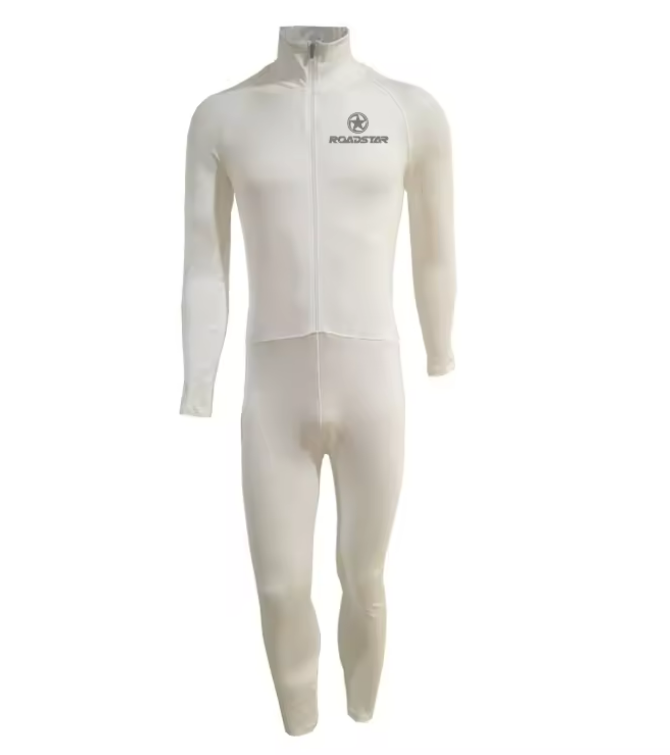
Manufacturers apply polyurethane and rubberized coatings to specific high-speed zones. The coating mechanism creates a completely smooth, impermeable surface. This finish minimizes skin friction as air flows over flat body planes. The application process involves bonding a micro-thin layer of liquid PU to a stretchable nylon base. However, these specialized coatings have strict performance limitations. They offer absolutely zero breathability. If applied too thickly, they severely restrict the stretch of the underlying fabric. Designers use them sparingly to avoid overheating the athlete, calculating the exact thickness required to smooth the airflow without turning the suit into a rigid shell.
Textured textiles cover leading edges like shoulders, upper arms, and thighs. They mimic the "golf ball effect" to create intentional micro-turbulence. This engineered roughness keeps the boundary layer of air attached to the body longer, significantly reducing the low-pressure wake trailing behind the skater. Industry leaders rely on proprietary textiles from specialized European mills that engineer specific aerodynamic structures woven directly into the fabric. Evaluation relies heavily on rigorous wind tunnel validation. Engineers test these fabrics at specific yaw angles and velocities ranging from 40 to 60 km/h, analyzing how different dimple patterns perform under varying wind conditions.
Base construction relies heavily on high-gauge elastane and nylon or polyester blends. These materials dominate high-mobility zones like joints, groins, and underarms, providing the necessary four-way stretch and baseline compression. Key evaluation metrics include fabric weight, measured in grams per square meter (GSM), typically ranging from 180 to 250 GSM for elite suits. Recovery rate is equally critical. High recovery prevents the fabric from bagging or sagging over time. The blend ratio between nylon and elastane determines the fabric's durability and stretch profile. Higher elastane content (often 20-30%) increases stretch but requires tight weaving to maintain durability.
Short track and mass start events mandate the use of cut-resistant materials. These take the form of integrated base layers or localized protective panels. High tensile strength fibers resist sharp blade penetration during high-speed crashes. Common materials include Kevlar®, Dyneema®, and other High-Performance Polyethylene (HPPE) variants. Evaluation metrics focus strictly on standardized safety ratings. Materials must meet EN 388 or ISO 13997 cut resistance standards. Governing bodies typically require Level 3 to Level 5 protection. These fibers must be woven in a way that maintains flexibility, as stiff protective panels will hinder the skater's mobility.
Material Type | Primary Characteristic | Flexibility | Common Application |
|---|---|---|---|
Dyneema® (UHMWPE) | Extremely high tensile strength, cool to the touch | High | Full-body short track undergarments |
Kevlar® (Aramid) | High heat and cut resistance | Medium | Localized protective panels (ankles, neck) |
HPPE Blends | Cost-effective cut resistance mixed with elastane | High | Training suits and developmental gear |
Long track disciplines focus heavily on aerodynamics and drag coefficients. Skaters race against the clock in individual lanes with minimal interference. Suits often feature integrated hoods and thumb loops to maintain high fabric tension across the entire body. Short track prioritizes safety, agility, and asymmetrical cornering forces. Skaters race in tight packs, drastically increasing collision and laceration risks. Aerodynamics remain important but are secondary to crash survivability. Drafting dynamics in short track also alter how airflow interacts with the suit. The turbulent air behind other skaters requires different fabric textures than the clean air experienced in long track events.
Manufacturers use computational fluid dynamics (CFD) to evaluate fabric placement virtually. Wind tunnel testing validates these digital models in the real world. Testing fabrics on static cylinders provides incomplete and often misleading data. Engineers must use dynamic mannequins that replicate the exact skating motion. The articulation of limbs changes how fabric stretches, which alters the surface texture and changes how air flows over the material. Dynamic testing ensures the suit performs optimally during actual race conditions, revealing aerodynamic flaws that only appear when the skater is in full stride.
All competitive Speed Skating Suits must strictly comply with International Skating Union (ISU) rules. The ISU heavily regulates aerodynamic additions to prevent unfair equipment advantages. Non-structural aerodynamic strips thicker than regulated limits are strictly prohibited. Suits cannot artificially alter the skater's natural body shape. The ISU also issues specific communications regarding mandatory cut-resistant zones for short track, dictating exact coverage areas for the neck, armpits, groin, and ankles. Manufacturers must stay updated on these evolving guidelines, as failing to meet ISU standards results in immediate disqualification during pre-race equipment inspections.
The inner face of the suit must interact smoothly with the athlete's skin. In short track, it must glide effortlessly over mandatory cut-resistant undergarments. High internal friction restricts movement and causes severe chafing. Low-friction internal weaves are absolutely necessary. They allow the outer shell to slide independently over base layers during extreme joint flexion. This compatibility ensures the skater maintains full range of motion. Athletes should never have to fight against their own equipment to achieve the proper skating posture.
An inverse relationship exists between the fastest rubberized fabrics and thermal comfort. Highly aerodynamic PU coatings trap body heat effectively. Overheating degrades physical performance rapidly on the ice. Elevated core temperatures cause premature muscle fatigue, negating any aerodynamic gains. Designers must meticulously map the body's sweat zones, placing breathable, non-coated fabrics in low-drag areas like the armpits and inner thighs. Managing this trade-off requires extensive athlete feedback and thermal imaging during prototype testing to ensure the suit vents heat without catching air.
High-elastane and PU-coated fabrics have a surprisingly limited lifespan. UV exposure, sweat, and repeated stretching degrade the recovery properties rapidly. As elastane breaks down, the suit loses its compressive, skin-tight fit. Micro-wrinkles begin to form across the surface of the garment. These wrinkles destroy aerodynamic efficiency by creating unwanted drag parachutes. Elite skaters often replace suits frequently to maintain peak material performance. Monitoring the fabric for signs of sagging or elasticity loss is a critical maintenance task for coaches and equipment managers.
The most advanced fabrics are completely useless if the suit does not fit perfectly. Loose fabric creates aerodynamic drag that slows the skater down. Highly rigid aerodynamic fabrics require precise, laser-measured custom tailoring. They lack the forgiving stretch of basic spandex blends. This precision increases procurement lead times and manufacturing complexity. Off-the-shelf suits compromise on fit to accommodate various body types, which leaves performance on the table. Elite performance demands custom tailoring to maximize the fabric's technical properties, ensuring aerodynamic textures sit exactly where they are needed.
Procurement teams must analyze the financial investment required for elite composite suits versus developmental nylon/spandex blends. High-end suits utilize proprietary European textiles and require extensive wind-tunnel validation, driving up development costs. Teams must calculate the expected competitive lifespan of the suit. Elite PU-coated models often maintain peak aerodynamic efficiency for just one season before the elastane degrades. Developmental programs may opt for highly durable, uncoated elastane blends that sacrifice marginal aerodynamic gains for multi-season longevity and easier maintenance.
High-performance textiles require strict and specific care protocols. Improper laundering instantly strips delicate polyurethane coatings. Heat and harsh detergents break down elastomeric yarns at a microscopic level, ruining the suit's aerodynamic profile and its compressive qualities.
Wash immediately after use to prevent acidic sweat from degrading the elastane bonds.
Hand-wash only in cold water (below 30°C) to protect polyurethane coatings from melting or delaminating.
Use specialized, pH-neutral sports detergents free of fabric softeners or bleach.
Never wring or twist the fabric; gently press the water out using a clean towel.
Air dry flat on a drying rack, keeping the suit away from direct sunlight or artificial heat sources.
A: The most effective fabrics combine dimpled polyurethane coatings and textured elastane blends. These engineered surfaces trip the boundary layer of air, creating micro-turbulence that reduces form drag. Smooth rubberized panels are also used on flat body planes to minimize skin friction. The specific combination depends on wind tunnel testing for optimal placement.
A: Short track racing involves tight packs and high collision risks. Governing bodies mandate the integration of cut-resistant fibers like Dyneema or Kevlar to prevent blade lacerations. Long track focuses almost entirely on aerodynamics, as skaters race in isolated lanes without the immediate threat of high-speed collisions.
A: The suit must be exceptionally tight to maintain high fabric tension. This prevents aerodynamic wrinkling, which creates significant drag. However, the fabric must retain enough multi-directional stretch to allow extreme hip and knee flexion. It must not restrict the skater's deep crouching biomechanics or cause premature muscle fatigue.
A: The International Skating Union strictly regulates material thickness and prohibits non-structural aerodynamic attachments. Suits cannot artificially alter the skater's natural body shape. For short track, the ISU mandates specific cut-resistance safety certifications for all protective undergarments and integrated panels to ensure athlete safety during crashes.
A: High-performance fabrics degrade quickly under intense use. UV exposure, sweat, and washing break down elastane and polyurethane coatings. Once the fabric loses its recovery rate and begins to wrinkle, it loses its aerodynamic advantage. Elite suits often last only a single competitive season before requiring replacement.


