
- CUSTOM PRODUCT
- PRODUCTS & DESIGN
- COMPANY & BRAND
- NEWS
- CONTACT US
Views: 0 Author: Site Editor Publish Time: 2026-11-29 Origin: Site


Effective custom speed skating suit design combines strategic fabric panel placement, consistent team colors, and clearly positioned logos without compromising the suit's aerodynamic fit. High-stretch panels support the skating crouch, while carefully positioned seams and aerodynamic fabrics help maintain a streamlined profile. Team logos and sponsor graphics should remain legible in the racing position and comply with applicable competition requirements. Evaluating a vendor for custom speed skating suit design requires looking beyond basic aesthetics. This guide breaks down the technical evaluation criteria for panel architecture, fabric dyeing technologies, and strategic logo placement to ensure optimal performance and professional presentation across both ice and inline disciplines.
Panel Placement Dictates Performance: Modern race suits utilize 6 to 15 different materials; custom designs must align seams and fabrics with the athlete's biomechanics to minimize drag and provide discipline-specific protection.
Fit Operates on "Negative Ease": A speed skating suit is cut smaller than the athlete's body. Design elements must account for extreme fabric stretch without distorting logos or causing sheer spots.
Sublimation Over Surface Printing: To maintain fabric breathability and aerodynamic integrity, colors and logos must be dye-sublimated rather than screen-printed.
Compliance and Clean Aesthetics: Governing bodies strictly regulate logo sizes and placements. Furthermore, modern team preferences lean heavily toward clean, professional designs over cluttered, slogan-heavy patterns, utilizing consistent typography across all event-specific variations.
Table of Contents
The primary function of a speed skating suit is to reduce aerodynamic drag while allowing maximum range of motion in a crouched position. Design must serve this function first. Every seam, fabric transition, and zipper placement impacts how air flows over the athlete's body. When evaluating custom apparel, technical construction holds absolute priority over visual styling. You cannot fix a poorly patterned garment with a flashy graphic.
Modern racing garments are complex composite structures. High-performance speed skating suits can combine multiple technical fabrics to meet the different aerodynamic, stretch, and durability requirements of specific body zones. Leading edges, such as the forearms and shins, often utilize dimpled aerodynamic fabrics. These textured surfaces trip the boundary layer of air, delaying flow separation and reducing wake drag behind the skater's limbs. Joints require high-stretch elastane blends with 4-way stretch capabilities for unrestricted mobility. The inner thighs demand friction-resistant materials to prevent chafing during rapid crossover steps.
Material requirements shift dramatically based on the racing environment. Ice suits prioritize thermal regulation and aerodynamic boundary layers. The cold, controlled indoor environment allows for lighter, highly specialized aerodynamic textiles. Manufacturers often use polyurethane-coated materials on the lower body to compress muscles and slice through the dense, cold air of an indoor rink.
Conversely, a custom inline speed skating suit must integrate high-abrasion resistant panels on the hips and shoulders. Kevlar blends or reinforced nylon protect athletes against severe road rash during asphalt falls. Inline skaters also deal with high heat and humidity. Their suits require extensive moisture-wicking mesh panels across the back and underarms to prevent overheating.
Assess whether a custom manufacturer allows design integration across complex, multi-fabric templates. Some vendors restrict custom designs to basic, single-material suits to save on manufacturing costs. A single-material garment cannot provide the targeted compression, aerodynamics, and protection required for competitive racing. You need a vendor capable of printing and assembling multi-textile patterns without losing structural integrity.
Seam placement directly impacts boundary layer airflow. Airflow behaves differently across various parts of the skater's body. Smooth, laminar flow is easily disrupted by raised edges. Strategic seam placement channels air efficiently, while poor placement creates turbulence and measurable drag. Wind tunnel testing consistently shows that exposed seams on leading edges drastically increase the athlete's overall drag coefficient.
Placing heavy design elements or thick seams across high-velocity airflow zones increases drag. Shoulders, forearms, and the leading edge of the thighs are critical aerodynamic zones. Seam placement should be coordinated with the fabric panel layout to minimize unnecessary surface disruption while preserving the stretch and fit required for skating movements. Manufacturers achieve this by wrapping a single continuous panel of fabric from the front of the leg to the back, placing the connecting seam in the low-pressure wake zone behind the hamstring.
Stitch type also matters. Flatlock stitching and bonded seams are commonly used in performance garments to reduce seam bulk and improve comfort. Conventional overlock construction can create more pronounced seam allowances, making seam placement and finishing important in close-fitting racing suits. Bonded seams use heat and adhesive tape to join panels, completely eliminating thread and creating a perfectly flat aerodynamic profile.
Performance suits operate on the principle of "negative ease." This means the suit is cut significantly smaller than the athlete's actual physical measurements. The garment acts as a second skin, requiring the stretch of the fabric to conform tightly to the body. The amount of negative ease is determined by the fabric's stretch and recovery characteristics, the intended compression level, and the garment pattern, rather than by a fixed percentage for every skater.
Proper negative ease ensures zero fabric bunching. Wrinkles and loose fabric act as miniature parachutes, catching air and slowing the skater down. Zipper placement also plays a role here; asymmetrical zippers that curve away from the center of the chest prevent the fabric from bunching at the neckline when the skater bends forward.
Extreme fabric stretch presents a unique challenge for custom designs. Patterns, logos, and colors must be mathematically scaled. If a vendor does not account for negative ease, circular logos will stretch into ovals, and straight lines will warp across the athlete's musculature. Manufacturers can adjust artwork within the pattern layout and verify its proportions through digital mockups and physical fit samples. They compress the digital logo on the flat pattern so it stretches into perfect proportion once worn by the athlete.
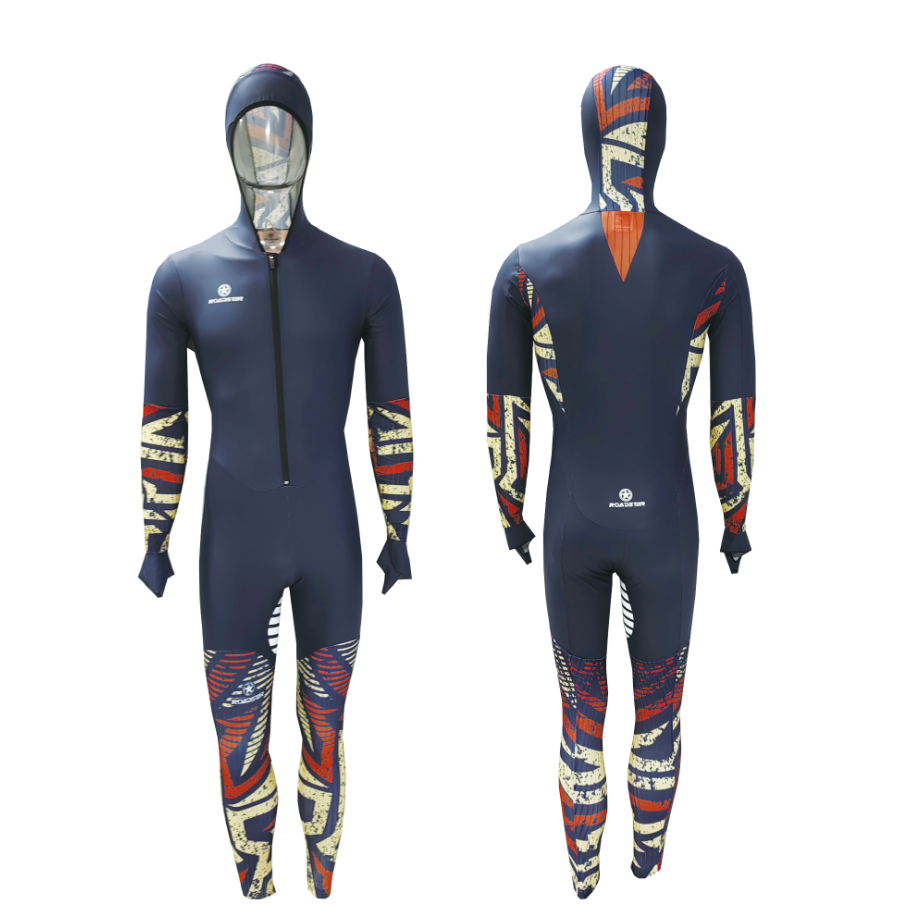
Applying color to technical fabrics without compromising the material's physical properties requires specialized technology. The chosen method dictates the suit's breathability, weight, and aerodynamic profile. You cannot treat technical sports apparel like a standard cotton t-shirt.
Dye-sublimation infuses ink directly into the fabric fibers. Under high heat (typically around 400 degrees Fahrenheit) and pressure, solid dyes transition into a gas and bond permanently with the polymer molecules of the fabric. Because sublimation dyes are incorporated into suitable polyester fibres rather than forming a thick surface layer, the process generally preserves the fabric's flexibility, breathability, and surface texture. The ink becomes part of the fabric itself.
Screen printing or heat transfers apply a layer of ink or vinyl on top of the fabric. This adds weight, creates rigidity, and blocks moisture transfer. More importantly, surface printing creates raised edges that disrupt airflow and increase aerodynamic drag. When stretched, screen-printed logos crack and peel, ruining the professional appearance of the garment. Dye-sublimation is a strong option for detailed graphics on suitable polyester panels, while logos applied to coated or specialty fabrics should use printing methods compatible with their surface and stretch properties.
Because modern suits use multiple fabrics like mesh, lycra, and rubberized aero-panels, achieving uniform color is difficult. A single hex code or Pantone color will absorb and reflect light differently on each material. A navy blue might look rich on smooth lycra but appear washed out on a textured aerodynamic mesh. These differences can result from fabric texture, surface reflectance, and dye uptake, while metamerism can also cause colors to match under one light source but differ under another.
Require vendors to provide physical fabric strike-offs before full production. A strike-off is a color swatch printed on the exact suit materials. This physical proof allows you to verify color consistency across all panel types under real-world lighting conditions. Professional manufacturers use D65 lighting boxes to ensure colors match perfectly across different textiles. Do not rely on digital proofs viewed on a computer monitor. Monitors emit light, while fabric reflects it. Only physical strike-offs prevent mismatched panels on the final garment.
When dark colors are sublimated onto white base fabrics, stretching the material can expose the un-dyed fibers underneath. This phenomenon is known as "grinning" and results in sheer, semi-transparent spots, particularly across the glutes, lower back, and thighs. Grinning makes the suit look cheap and compromises athlete modesty.
High-quality vendors mitigate this risk by using pre-dyed base fabrics for high-stretch areas. For high-stretch dark panels, manufacturers can use solution-dyed or pre-dyed fabrics and apply contrasting logos through compatible printing, transfer, or separate panel construction methods. Pre-dyed fabrics maintain their deep color regardless of how far they stretch. This prevents sheer spots and ensures the suit remains fully opaque throughout its lifespan. Check the GSM (grams per square meter) of the base fabric. A higher GSM indicates a denser knit, which further reduces the risk of grinning.
Balancing sponsor visibility, team identity, and strict regulatory compliance is a core challenge in custom apparel. A well-executed design projects professionalism without creating a cluttered, amateurish aesthetic. Sponsors pay for visibility, but governing bodies penalize rule violations.
Competition rules can restrict the size, number, and placement of sponsor and manufacturer logos on speed skating suits. Under ISU requirements, permitted markings vary by garment area and equipment type, so upper-body and lower-body logos must be checked against the applicable limits. National federation and event-specific requirements should also be reviewed before the final artwork is approved. Non-compliance can result in disqualification or forced taping over of logos at the starting line.
Logos must be positioned for visibility in the skating crouch, not just when standing upright. The lower back, outer thighs, and upper arms offer the best visibility during a race. A logo placed squarely on the chest may be completely obscured when the athlete is bent over in the skating position. Test your digital mockups by visualizing the athlete in a 90-degree crouch. Ensure primary sponsor logos remain unobstructed by the skater's arms or folded torso.
Maintain brand consistency through standardized typography and core color palettes across all team apparel. Consistent fonts and color blocking make a team instantly recognizable on the track or ice. Use highly legible, bold typography. Spectators and cameras need to read the team name while the athlete travels at 50 kilometers per hour.
High-tier custom designs allow for the integration of customizable elements. You can incorporate unique graphics for a host location or a specific championship event without breaking the core visual identity. This modular approach to design keeps the team aesthetic fresh while maintaining brand cohesion. Swap out secondary accent colors or add subtle background watermarks to denote specific racing seasons.
The market has shifted heavily toward clean, professional aesthetics. Elite athletes and teams actively avoid overly busy graphics and text-heavy designs. Phrases like "rule the race" or aggressive slogans detract from the professional appearance of the garment. They make the suit look like a novelty item rather than elite sporting equipment.
Minimalist designs project higher authoritativeness. Clean color blocking and strategic negative space ensure that primary team identifiers and sponsor logos stand out clearly. A cluttered suit dilutes brand impact and makes it difficult for spectators and cameras to identify the skater. Give your logos room to breathe.
Low-resolution JPEG or PNG logos can become pixelated when enlarged for full-body garment printing, while vector artwork preserves sharp edges at different sizes. Raster images are built from a fixed grid of pixels and cannot be enlarged without losing quality. A logo that looks sharp on a smartphone screen will look terrible when blown up to cover an athlete's thigh.
Outline the strict requirement for vector files during the design handoff. Formats such as .AI, .EPS, or .SVG use mathematical equations to render shapes, allowing them to scale infinitely without any loss of resolution. Color files should follow the printing supplier's recommended color profile and production workflow. Accurate fabric color matching is best confirmed through physical print samples, particularly when the design uses multiple fabric types.
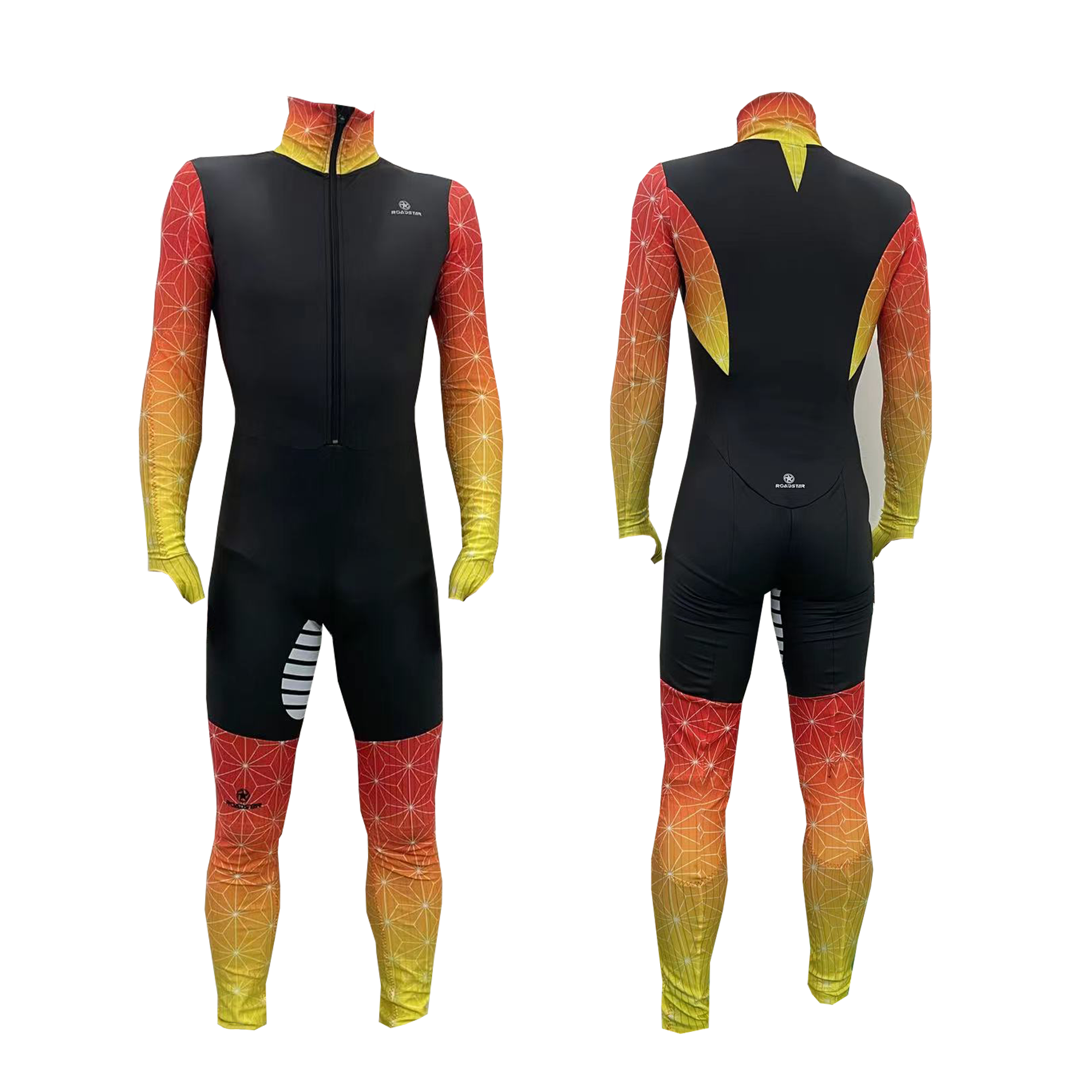
Procuring team apparel requires deciding between modifying an existing template or engineering a suit from scratch. Each model offers distinct advantages regarding fit, scalability, and lead times. You must align your procurement strategy with your team's budget and performance goals.
The semi-custom approach utilizes standard sizing charts but allows for specific proportional modifications. For example, an athlete might require a medium chest measurement but a longer leg inseam. The manufacturer adjusts the existing digital pattern to accommodate these specific limb lengths. They grade the pattern up or down in specific zones without altering the core aerodynamic architecture.
This model is highly cost-effective for clubs and growing athletes. It offers a tailored fit without the bespoke price tag. Semi-custom strikes a practical balance between aerodynamic efficiency and budget constraints. It allows teams to outfit dozens of skaters quickly without requiring individual 3D body scans.
Full custom involves individual 3D body scanning or extensive manual measurements to draft a unique pattern for a single athlete. The garment is engineered from the ground up to match the exact contours of the skater's body. Manufacturers often create a physical toile—a prototype suit made from cheap fabric—to test the fit before cutting the expensive technical textiles.
Full custom pattern drafting is particularly valuable for elite athletes who require precise fit adjustments and individualized aerodynamic panel placement. It allows the suit to be refined around the skater's body measurements and racing posture, reducing unnecessary fabric tension and wrinkles. By eliminating every micro-wrinkle and perfectly aligning aerodynamic panels with the athlete's specific musculature, full custom suits deliver maximum drag reduction. However, this process requires significant time and financial investment.
Compare the scalability of both models before committing to a vendor. The procurement model dictates your ability to manage team growth and replacement gear.
Procurement Model | Fit Methodology | Minimum Order Quantities (MOQs) | Typical Lead Time | Best Application |
|---|---|---|---|---|
Semi-Custom | Standard sizing with limb length adjustments | Low (Often 1-5 units) | 4 to 6 weeks | Clubs, amateur teams, growing youth athletes |
Full Custom | Bespoke pattern drafting via 3D scan or manual metrics | High initial order, varying reorder minimums | 8 to 12 weeks | Elite professionals, national teams, Olympic competitors |
Stock Template | Off-the-rack sizing, no structural changes | None | 1 to 2 weeks | Beginners, practice gear, emergency replacements |
Selecting the right manufacturing partner ensures your technical requirements translate into high-performance physical garments. Use this checklist to vet potential vendors. Do not rely solely on their marketing materials.
Ordering a full team run based solely on a digital mockup leads to sizing disasters. Digital renderings cannot demonstrate how negative ease interacts with different body types. A medium on a digital screen tells you nothing about how the suit compresses the athlete's thighs.
Only partner with vendors who provide physical "fit kits." A fit kit consists of blank sizing suits in various dimensions. Having the team try on physical samples prior to finalizing the order ensures accurate sizing and validates the manufacturer's pattern cutting expertise. Have your athletes assume the skating crouch while wearing the fit kit to check for mobility restrictions or fabric bunching.
The origin of the textiles directly impacts the suit's durability and aerodynamic performance. Generic, unbranded spandex degrades quickly under UV exposure and repeated stretching. It loses its elasticity, causing the suit to sag and catch air.
Reputable manufacturers will disclose the origin and technical specifications of their aerodynamic fabrics. Look for vendors sourcing Swiss or Italian milled technical textiles. Companies like Schoeller or Carvico lead the industry in producing high-compression, low-drag sporting fabrics. Ask your vendor for the specific brand and composition of the textiles they intend to use.
Teams need the ability to order one or two replacement suits next season without paying setup fees again. High minimum order quantities on reorders force teams to hold unnecessary inventory. A skater might rip their suit in a crash mid-season, and you need a replacement fast.
Ensure the vendor keeps digital design files and custom patterns on file indefinitely. Prioritize manufacturers with no-minimum reorder policies. This scalability is critical for managing roster changes and replacing damaged gear mid-season. Ask about their archival process for digital patterns and color profiles.
Gather accurate physical measurements for every team member and request a blank sizing fit kit from your top two manufacturing candidates.
Secure high-resolution vector files (.AI, .EPS, or .SVG) for all sponsor logos and verify they meet governing body size regulations.
Request physical fabric color strike-offs from the vendor to verify color consistency across all dimpled, mesh, and lycra materials.
Finalize your procurement model by confirming the vendor's minimum order quantities and lead times for mid-season replacement suits.
A: It operates on "negative ease," meaning it is cut smaller than the body. It should fit like equipment, not clothing. The tight fit eliminates wrinkles, prevents fabric bunching, and reduces aerodynamic drag when the athlete is in the crouched skating position.
A: While both prioritize aerodynamics and negative ease, inline suits often incorporate abrasion-resistant panels like Kevlar to protect against asphalt falls. Ice suits focus more heavily on thermal regulation and boundary layer airflow for controlled indoor environments.
A: Semi-custom adjusts standard sizes, allowing modifications like altering leg or arm length on a medium template. Full custom requires drafting an entirely new pattern based on exact individual body measurements or 3D scans for a bespoke fit.
A: Different body zones require different properties. Suits use aerodynamic dimpled fabrics for leading edges to reduce drag, high-stretch elastane for joints to allow mobility, and friction-reducing materials for inner thighs to prevent chafing.
A: No. Screen printing adds rigidity, weight, and aerodynamic drag. It also blocks fabric breathability. All logos and colors should be dye-sublimated directly into the fabric fibers to maintain stretch and performance.
A: Vector files such as .AI, .EPS, or .SVG are required. These mathematical files ensure logos can be scaled to fit the suit infinitely without pixelation or blurring, unlike raster images such as JPEGs or PNGs.
A: Yes, governing bodies like the ISU have strict regulations. For ISU competitions, permitted logo sizes and placements differ between the upper body, lower body, and specific equipment items, so teams should verify the applicable marking requirements before approving the final suit design.


