
- CUSTOM PRODUCT
- PRODUCTS & DESIGN
- COMPANY & BRAND
- NEWS
- CONTACT US
Views: 0 Author: Site Editor Publish Time: 2026-08-10 Origin: Site


Partnering with the wrong apparel factory carries hidden financial and reputational costs. Missed seasonal drops, inconsistent sizing across production runs, and catastrophic fabric failure during athletic performance permanently damage brand credibility. Scaling a sportswear brand, outfitting a large athletic organization, or operating as a teamwear distributor requires moving far beyond basic wholesale blanks. You need purpose-built, performance-driven garments. Vetting cut-and-sew production partners remains an opaque, high-risk process filled with miscommunication and misaligned expectations.
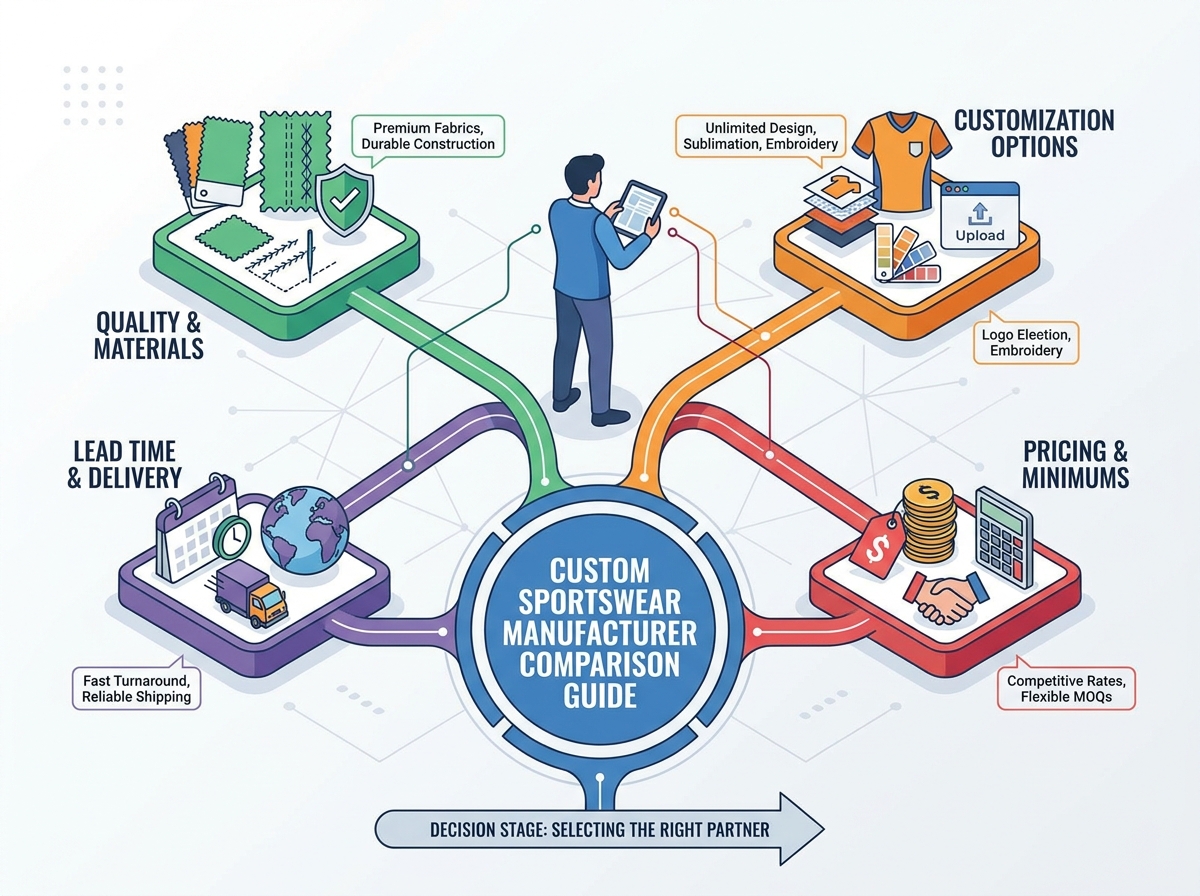
Approaching a factory without a clear understanding of their specific capabilities leads to wasted sampling fees and months of delayed development. This guide provides a technical framework to evaluate, compare, and select a reliable custom sportswear manufacturer based on production models, technical capabilities, and risk mitigation strategies. By understanding how factories operate behind the scenes, you establish a secure, scalable supply chain supporting long-term growth.
Pre-Sourcing Alignment is Crucial: Defining your target sport, product function, and target price point is a mandatory step before requesting quotes from any factory.
Production Models Dictate Control: Choosing between OEM (Original Equipment Manufacturer) and ODM (Original Design Manufacturer) determines your upfront investment, lead times, and ownership of the final design.
True Cost Goes Beyond the Unit Price: A reliable evaluation must account for sampling fees, freight, import tariffs, and acceptable defect rates, not just the quoted manufacturing price.
MOQs Are Tied to Sourcing and Technique: Minimum Order Quantities directly impact your fabric sourcing options; true custom performance fabrics require higher minimums than stock materials or sublimated teamwear.
Prototyping is the Ultimate Litmus Test: Prioritize manufacturers that utilize 3D digital sampling and transparent physical prototyping (Fit, Pre-Production, and Top-of-Production samples).
Table of Contents
Brands must finalize their target sport, end-user expectations, and retail margins long before approaching a factory. A facility specializing in lightweight, highly breathable running gear often lacks the heavy-duty flatlock stitching machinery required for grappling rash guards or rugby kits. Defining the product function dictates the construction methods, fabric weights, and necessary machinery. You cannot expect a factory that primarily sews basic cotton t-shirts to suddenly execute complex four-way stretch activewear with gusseted crotches and bonded seams.
Establishing your target retail margin is equally necessary. Approaching a high-end technical facility with a budget suited for promotional giveaway apparel wastes time for both parties. You must align your desired market positioning with the factory's typical output quality. If your brand promises high-compression, squat-proof leggings for elite athletes, you must partner with a manufacturer capable of sourcing premium elastane blends and executing rigorous tension testing. High-performance output naturally demands higher manufacturing investments.
Before sending a single email to a supplier, document your exact requirements. Know whether you need moisture-wicking treatments, anti-microbial finishes, or specific UV-protection ratings. Factories respect buyers who know exactly what they want. Vague inquiries signal inexperience and often result in inflated quotes or outright rejection from top-tier facilities.
The OEM model requires the factory to build your garment entirely from scratch based on your exact specifications. This approach fits brands requiring 100% custom tech packs, unique grading rules, specific fit profiles, and proprietary fabric blends. OEM allows you to build a strong, defensible brand identity because the silhouette and material composition belong entirely to you. You control every millimeter of the garment, from the width of the waistband to the exact placement of reflective heat transfers.
However, OEM comes with significant trade-offs. Factories require higher Minimum Order Quantities (MOQs) because they must source custom fabrics and calibrate machinery for a completely new pattern. Development timelines stretch substantially longer, often taking several months just to finalize the physical prototype. Successfully executing an OEM strategy necessitates having in-house or contracted technical design expertise to create accurate tech packs, call out specific stitch types, and manage the fit iteration process.
When operating under OEM, you carry the burden of product development. If the tech pack contains a flaw in the grading rules, the factory will produce a flawed garment exactly to your specifications. You must provide comprehensive Bill of Materials (BOM) documents, graded spec sheets, and vector illustrations. The factory acts as the executor of your vision, not the creator.
The ODM model involves selecting pre-existing garment designs developed by the factory and applying your branding. This strategy works well for teams, clubs, distributors, and emerging brands prioritizing speed-to-market and lower initial capital. Because the factory already holds the patterns and fabric inventory, production begins almost immediately after artwork approval. You bypass the lengthy pattern-making and fit-testing phases entirely.
The primary trade-off with ODM is the strict limitation on customization. Modifications remain restricted to surface-level changes like sublimation, screen printing, embroidery, or minor tweaks to existing factory templates. You do not own the intellectual property of the garment silhouette. Competing brands could potentially source the exact same base garment from the same facility. If unique structural design forms a core pillar of your brand, ODM eventually becomes a limiting factor.
Despite these limitations, ODM provides a highly effective launchpad. Many successful activewear companies start with ODM to test market demand and generate initial revenue before reinvesting those profits into custom OEM development. It allows you to focus entirely on marketing, sales, and community building rather than getting bogged down in supply chain technicalities.
Athletic apparel lives and dies by its fabric performance. When evaluating a custom sportswear manufacturer, you must assess their ability to source and process technical textiles consistently. Request fabric swatches and review the Grams per Square Meter (GSM) consistency. A reliable factory maintains strict GSM tolerances across different dye lots to ensure your garments do not feel drastically different from one production run to the next.
Test the four-way stretch recovery. High-quality athletic wear must snap back to its original shape after extreme tension. Poor elastane quality leads to bagging at the knees and elbows after a single workout. Investigate their moisture-wicking treatments and colorfastness under athletic stress. Fabrics must resist fading when exposed to sweat, UV light, and frequent heavy-duty washing. Ask the factory for their testing protocols regarding pilling resistance and color crocking (color transfer during friction).
Evaluate the factory's access to verifiable eco-friendly materials. Sustainable tech rapidly sets the baseline for consumer expectations. Check if the manufacturer sources certified recycled polyesters (rPET), organic cotton blends, and utilizes low-water or waterless dyeing processes. Request certifications like OEKO-TEX Standard 100 or Global Recycled Standard (GRS) to validate their sustainability claims. Do not accept verbal assurances; demand the actual certificate numbers and verify them.
Fabric Blend | Typical GSM Range | Key Performance Properties | Best Suited For |
|---|---|---|---|
Polyester / Spandex (80/20) | 220 - 280 GSM | High compression, moisture-wicking, durable. | Yoga pants, compression tops, MMA rash guards. |
Nylon / Elastane (75/25) | 180 - 240 GSM | Buttery soft hand-feel, excellent stretch recovery, matte finish. | Premium athleisure, women's activewear, sports bras. |
100% Micro-Mesh Polyester | 120 - 160 GSM | Maximum breathability, lightweight, holds sublimation ink perfectly. | Basketball jerseys, running singlets, soccer kits. |
Cotton / Polyester / French Terry | 280 - 350 GSM | Thermal retention, structured drape, high durability. | Warm-up hoodies, joggers, lifestyle pump covers. |
Minimum Order Quantities represent the biggest hurdle for new brands. Small-batch teamwear drastically impacts per-unit costs. Factories charge premiums for low-volume runs because the labor required to set up cutting machines, thread sewing stations, and calibrate printing equipment remains the same whether they produce 50 units or 5,000 units. The setup time eats directly into their profit margins on small orders.
MOQs vary drastically based on the manufacturing technique. Sublimated teamwear allows for much lower minimums—sometimes as low as 10 units—because the design prints digitally onto white polyester rolls before cutting. Conversely, custom-dyed, cut-and-sew performance apparel requires high-volume fabric commitments. Fabric mills typically require hundreds of kilograms of yarn to run a custom dye batch. The garment factory passes those high MOQs directly onto you.
You must evaluate a manufacturer's scaling capacity. A boutique factory might execute a flawless 50-unit pilot run but completely collapse under the logistical weight of a 5,000-unit commercial order. Ask potential partners specific questions about their infrastructure:
What is your maximum monthly production capacity for cut-and-sew activewear?
How many active sewing lines operate in your facility?
Do you outsource overflow production to sub-contractors during peak seasons?
How do you scale your quality control teams when production volume spikes?
Prototyping serves as the ultimate litmus test for a factory's technical competence. Modern manufacturers increasingly utilize 3D digital sampling software like CLO 3D or Browzwear. Digital sampling drastically reduces fabric waste and accelerates the iteration process. You review drape, tension maps, and colorways digitally, eliminating two or three rounds of physical sampling before a needle ever pierces fabric.
Once digital approval completes, you navigate the physical sample stages. Never accept a single prototype as final approval for bulk production. Break down the required physical checkpoints to ensure absolute accuracy:
Fit Samples: Made from available substitute fabrics to test the sizing, grading, and overall silhouette on a live fit model. This stage ignores color and focuses entirely on structure.
Pre-Production (PP) Samples: Created using the exact bulk fabric, trims, and colors. This represents the final absolute approval before the factory cuts the bulk fabric rolls.
Top-of-Production (TOP) Samples: Pulled directly from the first batch of the actual bulk run. This verifies that the assembly line matches the approved PP sample perfectly before the rest of the order finishes.
Domestic manufacturing offers distinct logistical and operational advantages. Brands benefit from significantly faster freight shipping, the complete elimination of import tariffs, and easier communication due to shared time zones and language. USA-based facilities operate under strict labor compliance laws, offering peace of mind regarding ethical manufacturing. Domestic production provides stronger legal protection for your intellectual property, allowing you to enforce NDAs and patents effectively.
However, the disadvantages remain substantial. Unit costs run significantly higher due to domestic labor rates. More importantly, domestic factories often lack cut-and-sew scalability for highly complex performance wear. Specialized machinery required for advanced athletic garments—like seamless knitting machines or ultrasonic welders—is heavily concentrated in overseas hubs. Producing highly technical gear domestically at scale proves difficult and expensive.
Overseas manufacturing hubs remain the global standard for technical athletic apparel. The primary advantage lies in access to advanced, specialized machinery. Techniques like seamless knitting, laser cutting, ultrasonic welding, and bonded seams represent standard practice in top-tier Asian and Latin American facilities. These regions offer highly competitive unit costs when producing at scale, allowing brands to maintain healthy retail margins.
The trade-offs involve complex supply chain logistics. You navigate import duties, manage longer ocean or air freight times, and deal with potential language barriers. The absolute necessity of rigorous quality assurance oversight cannot be overstated. Without boots on the ground or a trusted third-party inspector, overseas production carries a higher risk of receiving a container of unsellable goods. You must build robust QA protocols into your vendor agreements.
The hybrid manufacturing model bridges the gap between domestic control and overseas scale. In this model, brands partner with a domestic agency or a manufacturer that maintains a local headquarters but owns or closely manages overseas facilities. You get the communication benefits of a local partner with the pricing benefits of an offshore factory.
This setup allows brands to handle tech pack creation, 3D digital sampling, fit sessions, and project management locally. You communicate with a domestic account manager who understands your market expectations. Once the PP sample gains local approval, the agency leverages their overseas facilities for cost-effective bulk production. This mitigates the communication and QA risks of direct overseas sourcing while maintaining the margin benefits of offshore manufacturing.
Manufacturing Model | Primary Advantages | Primary Disadvantages | Best Suited For |
|---|---|---|---|
Domestic (USA) | Fast shipping, no tariffs, easy communication, strong IP protection. | Higher unit costs, limited technical machinery, lower scalability. | Premium boutique brands, rapid-replenishment basics. |
Overseas Direct | Advanced technical capabilities, low unit costs at scale, high capacity. | Long freight times, import duties, complex QA oversight required. | Established brands with high volume and structured supply chains. |
Hybrid Model | Local project management, overseas pricing, streamlined sampling. | Slightly higher margins than direct overseas due to agency overhead. | Growing brands needing technical expertise without the offshore risk. |
The most devastating risk in apparel manufacturing involves receiving a bulk order with inconsistent sizing, faulty stitching, or incorrect fabric weights. A size medium in one colorway might fit like a small in another due to poor fabric relaxation before cutting. Stitching pops during athletic use if the factory substitutes high-stretch nylon threads for cheaper standard polyester threads.
To mitigate this, establish Acceptable Quality Limits (AQL) directly in the manufacturing contract before placing the deposit. An AQL 2.5 standard dictates exactly how many minor, major, and critical defects remain acceptable in a batch before you reject the entire run. For overseas production runs, hiring third-party inspection agencies is mandatory. These independent inspectors visit the factory to check the TOP samples, measure garments against the spec sheet, and conduct random batch testing before the factory loads the shipping container.
Implement specific testing protocols during the inspection phase. Require the inspector to perform pull tests on all seams, verify zipper functionality, and check logo placements with a measuring tape. Do not rely on the factory's internal QC report. Independent verification protects your investment and forces the factory to maintain high standards throughout the entire production run.
Missing a seasonal launch or failing to deliver a team's kit by opening day due to manufacturing bottlenecks destroys client relationships. Factories often overpromise on lead times to secure the deposit, failing to account for raw material delays, machine breakdowns, or national holidays.
Mitigate this by mapping the true timeline meticulously. A realistic schedule includes Tech pack approval, Fabric sourcing, Physical sampling, Bulk production, Freight transit, and Customs clearance. Advise your team to build in a minimum of three to four weeks of buffer planning for critical deadlines. Never assume the factory's stated production time includes the time it takes to source custom zippers or wait for a container ship to clear a congested port.
A constant risk exists of a factory leaking proprietary designs, custom patterns, or innovative fabric blends to competitors. Unscrupulous facilities might run ghost shifts to produce unauthorized overruns of your exact garment, selling them on secondary gray markets at a fraction of your retail price.
While international Non-Disclosure Agreements (NDAs) offer some psychological deterrence, their practical legal limits prove severe when dealing with overseas jurisdictions. The most effective mitigation strategies remain operational. Protect your brand identity by sourcing custom labels, branded aglets, and proprietary trims from entirely different suppliers. Ship these finished trims to the main garment factory for final assembly. If the factory lacks access to your branded hardware, they cannot easily replicate and sell your finished product.
Selecting a custom sportswear manufacturer depends entirely on your available capital, technical requirements, target market, and operational timeline. A factory executing flawless sublimated soccer jerseys may completely fail at engineering high-compression seamless yoga wear. Success requires treating the sourcing process as a strategic partnership rather than a simple transactional purchase. Apply strict shortlisting logic, audit technical capabilities thoroughly, and verify communication transparency before committing to a bulk order.
Take the following next steps to secure your production partner:
Finalize your technical documentation, ensuring your tech packs detail every measurement, stitch type, and trim placement.
Request physical fabric swatch books from your top three factory candidates to test stretch recovery and GSM consistency.
Order a Fit sample from your primary choice to evaluate their pattern-making accuracy before discussing bulk production.
Draft a vendor agreement that explicitly outlines your AQL 2.5 quality standards and third-party inspection requirements.
Request itemized production timelines that account for fabric sourcing, sampling, bulk assembly, and freight transit.
A: MOQs vary heavily by technique. Sublimated teamwear allows MOQs as low as 10 to 50 units. Fully custom cut-and-sew apparel using stock fabrics typically requires 100 to 300 units per style. If you require custom-dyed fabrics or proprietary blends, mills demand MOQs of 500 to 1,000 units to justify the machinery setup.
A: Physical sample costs generally run a multiple of the estimated bulk unit cost. This covers the disproportionate labor required to draft a single pattern, cut individual fabric pieces, and calibrate machines for a one-off garment. Many factories credit this sample fee back to your invoice if you proceed with a bulk order.
A: OEM means the factory builds a completely unique garment from scratch based on your custom tech packs and patterns. ODM means you select a pre-existing design developed by the factory and simply apply your own branding, colors, or surface prints.
A: A hybrid model utilizes a domestic agency or local headquarters to handle all communication, tech pack development, and project management. Once the prototype gains local approval, the agency manages the bulk production at their partnered overseas facilities, blending local accountability with offshore manufacturing scale.
A: The entire process usually takes 90 to 120 days. Tech pack development and sampling take 4 to 6 weeks. Once you approve the final sample, bulk production requires 30 to 45 days. Ocean freight and customs clearance add another 30 days to the timeline.
A: You must provide a comprehensive tech pack. This includes flat vector sketches, a detailed Bill of Materials listing all fabrics and trims, a graded spec sheet with exact measurements for all sizes, and specific callouts for construction methods like stitch types and seam allowances.
A: Never skip the prototyping phase. Request fabric swatches to test stretch and recovery. Order a Fit sample, followed by a Pre-Production sample in the exact bulk fabric. Establish Acceptable Quality Limits in your contract and hire a third-party inspection service to review the Top-of-Production samples.


