
- CUSTOM PRODUCT
- PRODUCTS & DESIGN
- COMPANY & BRAND
- NEWS
- CONTACT US
Views: 0 Author: Site Editor Publish Time: 2026-08-10 Origin: Site


Moving directly to bulk apparel manufacturing without rigorous physical sample validation carries severe financial and reputational risks. Sportswear is uniquely unforgiving. Minor miscalculations in stretch, moisture management, or seam placement quickly scale into massive, unsellable inventory. When athletes rely on your gear for performance, there is zero room for error. You cannot fix a restricted range of motion or a failing flatlock seam once thousands of units sit in a warehouse.
This guide provides a systematic evaluation framework for custom sportswear samples. You will learn exactly how to assess fit, fabric performance, and construction details. We outline the specific testing protocols required to validate athletic apparel before mass manufacturing begins. By implementing these strict approval processes, you can authorize bulk production with absolute confidence, eliminate costly rework, and protect your brand reputation.
The Pre-Production (PP) Sample is a Binding Contract: Never authorize bulk manufacturing without a finalized, physical PP sample that matches your exact specifications.
Dynamic Testing Over Flat Measurements: Sportswear must be evaluated in motion to assess compression, stretch recovery, and chafe resistance, not just measured flat on a table.
Tech Pack Synchronization: Every revision made during the sampling phase must be documented in an updated Tech Pack to maintain a single, indisputable source of truth.
Strict Tolerance Limits: Establish clear acceptable variance margins for Points of Measure (POM), stitching density, and fabric GSM before mass production begins.
Table of Contents
Skipping the physical sample phase triggers a compounding financial disaster. Bulk manufacturing errors waste raw materials, delay seasonal launches, and destroy brand equity. If a factory misinterprets a tech pack and produces ten thousand leggings with inadequate stretch, the entire run becomes dead stock. You cannot simply alter finished athletic garments. The seams are already cut, the fabric memory is set, and the dye lots are finalized. The cost of executing a few sample rounds is negligible compared to the total loss of a bulk production run.
Rigorous sampling acts as a financial safeguard for emerging brands. It prevents catastrophic capital loss on defective inventory. Small clothing labels operate on tight cash flow margins. A single botched bulk order can bankrupt a new business. By demanding physical prototypes, you force the factory to prove their technical capability before you release the bulk deposit. This transfers the risk of misinterpretation back to the manufacturer during the development phase, where mistakes only cost a few yards of fabric rather than entire shipping containers.
Athletic apparel requires stricter sampling protocols than casual wear. A standard cotton t-shirt only needs to drape correctly. A performance running top must manage sweat, stretch in four directions, and withstand high-impact friction. You must assess compression levels, fabric recovery, and seam durability under extreme stress. These sportswear-specific variables cannot be verified through digital renderings or flat patterns. Elastane degrades if exposed to incorrect heat settings during sublimation. Nylon blends pill if the yarn twist is too loose. You only discover these material failures by handling and testing a physical unit.
A successful sample phase aligns manufacturer capabilities with your brand expectations. Success means you have a physical garment that matches your tech pack perfectly. It means the factory has demonstrated they can source the correct technical fabrics, apply the right stitching techniques, and grade the sizes accurately across the entire spectrum. You only deploy large capital when the physical proof sits in your hands, fully vetted and tested by your team.
You must provide a comprehensive production definition before requesting any physical prototypes. Factories need context to source the right materials and assign the correct technical team. A vague request leads to inaccurate prototypes, endless email chains, and wasted weeks. The production brief acts as the executive summary of your tech pack. It sets the scope of work and establishes the baseline requirements for the factory floor.
Your production brief must outline specific core elements to ensure accuracy. Include the exact product category, such as high-impact sports bras, thermal cycling bibs, or lightweight running shorts. Define the fabric family required, noting specific blends like nylon-spandex, recycled polyester, or merino wool. You must also detail the construction level, specifying if the garment needs taped seams, flatlock stitching, laser-cut ventilation, or bonded hems.
Brief Component | Factory Requirement | Sportswear Example |
|---|---|---|
Product Category | Defines the assembly line and machinery needed. | High-compression weightlifting tights. |
Fabric Family | Directs the sourcing team to specific textile mills. | 75% Nylon / 25% Elastane, 250 GSM. |
Construction Level | Determines labor intensity and specialized equipment. | 4-needle 6-thread flatlock stitching, gusseted crotch. |
Size Range | Impacts marker making and fabric yield calculations. | Women's XS through XXL. |
Specialized Finishes | Requires secondary chemical treatments or coatings. | Silver-ion anti-microbial treatment, DWR coating. |
Provide the estimated quantity range and the complete size run. Factories use this data to determine if your project fits their minimum order quantities and production lines. Finally, list any specialized garment finishes required. If your athletic wear needs durable water repellent (DWR) coatings, anti-microbial treatments, or UV protection, state this immediately. These finishes dictate which fabric mills the factory will contact for your initial swatches, saving weeks of back-and-forth communication.
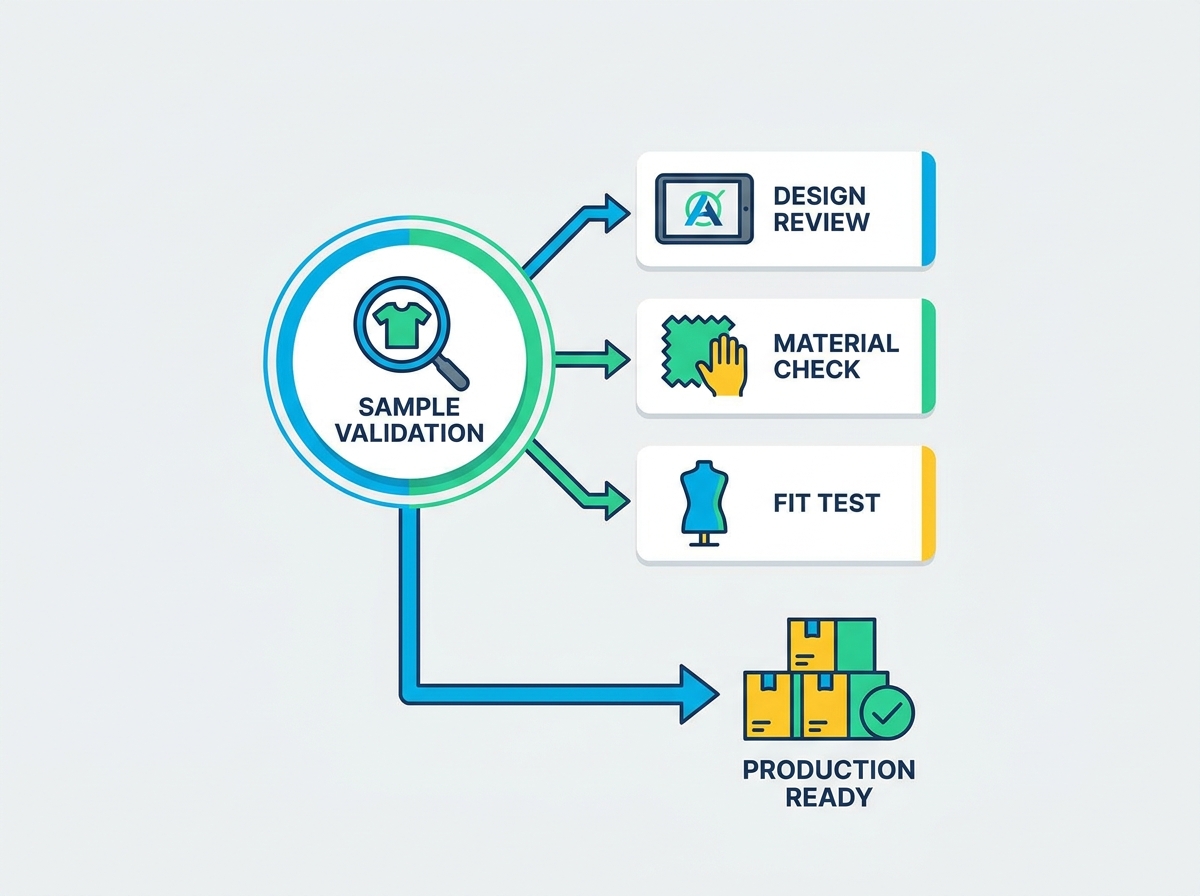
Garment sampling is a multi-step process. Each stage serves a distinct purpose in refining the final product. You cannot jump from a sketch directly to a pre-production sample. Moving methodically through these stages ensures structural integrity, sizing accuracy, and material performance.
Sample Stage | Primary Purpose | Material Used | Key Action Required |
|---|---|---|---|
Prototype / First Sample | Verify basic silhouette, design lines, and concept translation. | Available substitute fabric (similar weight/stretch). | Check overall proportions and design intent. |
Fit Sample | Evaluate drape, articulation, and baseline sizing accuracy on a live model. | Substitute or near-final fabric. | Pin, mark, and adjust the pattern for movement. |
Size Set Sample | Ensure grading rules translate correctly across all body types. | Near-final or final bulk fabric. | Verify that design elements do not distort on extreme sizes (XS, XXL). |
Pre-Production (PP) Sample | Establish the final benchmark and gold standard for the factory floor. | Exact bulk fabric, final trims, accurate colors. | Sign, date, and approve for mass manufacturing. |
The prototype verifies the basic silhouette. It translates your two-dimensional design into a three-dimensional object. Factories often use available substitute fabrics for this stage to save time. The goal is simply to see if the design lines, panel placements, and overall concept work in reality. You are not checking for perfect compression or exact color matching here.
The fit sample verifies baseline sizing. You must test this garment on a live fit model who matches your target demographic. Evaluate the drape and articulation during movement. This stage exposes restricted armholes, tight waistbands, or improper inseam lengths. You will likely pin the fabric, mark adjustments with chalk, and send detailed photos back to the pattern maker to refine the block.
The size set sample verifies your grading rules. You review a full size run, from extra small to double extra large. This ensures the pattern scales correctly across all body types. You must confirm that pocket placements, logo sizes, and color-blocking panels do not distort on the smallest or largest sizes. A pocket that looks perfectly proportioned on a medium might sit too low on an extra small if the grading rules are flawed.
The pre-production (PP) sample is the final benchmark. It must use the exact bulk fabric, trims, colors, and construction methods. The factory will use this specific garment as the gold standard for the assembly line. Never accept a PP sample that uses substitute materials. If the factory claims the final fabric is still in transit and offers a substitute for the PP approval, reject the request and wait for the actual material.
Measure all Points of Measure (POM) against your Tech Pack specifications. Lay the garment flat on a smooth, hard surface. Use a flexible fiberglass measuring tape. Check the chest width, waist, hip, front rise, back rise, and inseam. Compare these physical measurements to your graded spec sheet. Document any deviations down to the fraction of an inch. If the waist measures half an inch smaller than the spec, note it immediately.
Check the garment balance on a live fit model. The clothing must hang evenly. Ensure side seams run straight down the body without pulling forward or backward. Watch for seams that twist around the leg or arm during movement. Twisting indicates a pattern drafting error or incorrect fabric grain alignment during the cutting phase. A twisted seam on a compression tight will cause severe chafing during a long-distance run.
Verify sleeve length, leg openings, and inseams under tension. Sportswear stretches dynamically during use. Have your fit model perform sport-specific movements. Check if the sleeve rides up during a shoulder press. Confirm that the leg opening stays anchored during a deep squat. The garment must maintain its intended coverage when the fabric is fully extended. If a running short rides up the thigh after three strides, the inseam grading requires an immediate overhaul.
Test the stretch and recovery of the fabric. Pull the material to its maximum extension, hold it for thirty seconds, and release it. The fabric must return to its original shape immediately without rippling. If the knees or elbows bag out after a few minutes of wear, the spandex or elastane content is failing. Poor recovery ruins the compression benefits of athletic wear and leads to a sloppy, unprofessional fit.
Verify the fabric weight (GSM) and opacity. Cut a small square of the fabric and weigh it on a precision scale to confirm it matches your requested Grams per Square Meter. Conduct the squat test for leggings and shorts. Have the fit model bend deeply under bright, direct lighting. The fabric must remain completely opaque. Sheer athletic bottoms are an immediate reason to reject a sample and demand a higher-density knit.
Evaluate moisture-wicking capabilities, breathability, and colorfastness. Drop a small amount of water on the interior of the fabric. It should spread and absorb quickly, pulling moisture away from the skin. Wash the sample with a white cotton cloth in warm water to test for color bleeding. Athletic wear requires frequent, heavy washing. The dyes must remain stable, and the colors must not migrate onto lighter panels.
Verify specialized sportswear finishes. If you requested a Durable Water Repellent (DWR) coating, pour water over the exterior shell. The water must bead up and roll off instantly without saturating the top layer. Wash the garment three times and repeat the test. Finishes like anti-microbial or anti-odor treatments must survive initial wash cycles to provide actual, long-term value to the athlete.
Compare the seam types used against your technical requirements. Sportswear relies heavily on flatlock and overlock seams. Flatlock seams lay completely flat against the skin, offering maximum chafe resistance for base layers and running tights. Overlock seams provide excellent stretch but leave a raised edge on the interior. Ensure the factory applied the correct seam type to the correct panels as dictated by your tech pack.
Check the stitching density. Count the Stitches Per Inch (SPI) using a ruler. High-impact sportswear requires a higher SPI to maintain seam integrity under stress. Compare the physical SPI to your tech pack callout. Low stitch density leads to seam popping during athletic exertion. If the factory drops the SPI to speed up the sewing line, the garment will fail under pressure.
Test the thread tension. Pull the seams laterally with significant force. The thread should stretch with the fabric. If you hear popping sounds or see the thread snapping, the tension is too tight, or the factory used rigid polyester thread instead of a stretch-friendly nylon or textured bulk thread. Seams must flex seamlessly with the garment to accommodate explosive athletic movements.
Evaluate all zippers for smoothness and security. Zip and unzip the garment rapidly fifty times. The slider must move without catching the surrounding fabric or binding on the teeth. Check the locking mechanism on the zipper pull. When pressed flat, a semi-auto-lock zipper should not slide down, even under heavy lateral tension. This is critical for half-zip running tops and high-impact sports bras.
Inspect drawcords and aglets. Pull the drawcords tightly to test their tensile strength. Check the aglets (the plastic or metal tips) for security. They must be firmly attached to prevent the cord from fraying in the wash. Ensure the drawcord channel is wide enough to allow easy adjustment but narrow enough to prevent the cord from twisting or folding over on itself.
Test all elastics for memory and tension. Stretch the waistbands, bra bands, and cuff bindings. The elastic must provide firm compression without cutting into the skin. It must snap back to its original circumference instantly. Weak elastic will degrade rapidly after exposure to sweat, body heat, and laundry detergent. Fold the waistband over to ensure the elastic is securely tacked down and will not roll during wear.
Verify logo placement and scale. Measure the distance from the logo center to the nearest seam, hem, or neckline. Compare this exact measurement to your tech pack. Check the line thickness and color contrast. The factory must match your specific Pantone color codes exactly. A faded, crooked, or slightly off-brand logo diminishes the perceived value of the garment and signals poor quality control.
Test prints for cracking, peeling, or dye migration. Stretch the printed area to its maximum capacity. Screen prints and high-density silicone transfers must stretch with the fabric without cracking or flaking off. Check for dye migration, where the base fabric color bleeds into the printed logo. This often happens when printing white logos on dark, highly saturated polyester fabrics that were not properly cured.
Inspect dye sublimation panels for clarity. Sublimation should yield crisp, high-resolution graphics. Look for ghosting or blurred edges, which occur if the transfer paper shifts during the heat press process. The colors must penetrate the fabric deeply, leaving no white fibers exposed when the material stretches across the body.
Balancing sample costs with production timelines requires strict project management. Factories charge sample fees to cover the disproportionate labor required for single units. You must budget time for two to three revision rounds. International shipping adds weeks to the timeline. Plan your sampling phase months ahead of your seasonal launch window to avoid rushing approvals. If you compress the timeline, you will inevitably miss critical defects.
Understand manufacturing tolerances. No factory produces identical garments down to the millimeter. Establish acceptable variance margins. Accept minor variances that do not impact fit or performance. Demand a total recut if the variance affects the compression level, seam integrity, or primary sizing.
Point of Measure (POM) | Standard Acceptable Tolerance | Action if Exceeded |
|---|---|---|
Chest / Bust Width | +/- 0.5 inches | Reject and adjust pattern grading. |
Inseam Length | +/- 0.5 inches | Accept with written warning for bulk. |
Neckline Opening | +/- 0.25 inches | Reject; impacts head clearance. |
Sleeve Length | +/- 0.5 inches | Accept if articulation remains unaffected. |
Do not let a looming launch date force you into accepting a flawed sample. Approving a defective prototype to save two weeks will result in months of dealing with returns, negative reviews, and angry customers. Perfection in the sampling phase guarantees speed and efficiency on the bulk production floor. Hold your ground and demand accuracy.
Verbal or email approvals are insufficient. Every single revision must be formalized in an updated Tech Pack. If you tell the factory to lengthen a sleeve over a phone call, you have no legal recourse if the bulk order arrives incorrect. The Tech Pack is the only indisputable source of truth. Update the document, change the version number, highlight the revisions in red, and require the factory manager to acknowledge the new file in writing.
Provide actionable, objective feedback. Do not use vague statements like "make it tighter" or "improve the fabric." Use photos of the sample on a fit model. Draw digital lines and arrows on the photos indicating exactly where to take in the pattern. State exact measurement changes, such as "reduce front rise by 0.5 inches" or "increase bicep circumference by 0.75 inches." Clear, numerical data eliminates factory guesswork.
Use a strict decision matrix for requesting a second sample versus proceeding with notes. If the flaw involves pattern grading, fabric stretch, or critical seam construction, you must demand a completely new physical sample. If the flaw is a minor trim color change, a missing hangtag, or a logo placement shift of a few millimeters, you can safely approve bulk production with written, documented conditions attached to the purchase order.
Meticulously evaluating physical prototypes is the most effective insurance policy against catastrophic bulk production failures. Sportswear demands high-performance functionality. You cannot verify stretch recovery, moisture management, or seam strength through digital files. The physical sample proves the factory can execute your vision accurately and withstand the rigors of athletic use.
Partner with manufacturers who demonstrate transparency, patience, and precision during the sampling process. A factory that rushes you to approve a flawed prototype will cut corners on the assembly line. Choose partners who welcome your rigorous testing protocols and respond to technical feedback with updated, accurate iterations.
Take these final actions to authorize production:
Sign and date the approved physical PP sample with a permanent marker across the interior care label.
Keep one identical approved sample at your headquarters in a dark, climate-controlled space.
Ship the counter-sample directly to the factory floor to serve as the production benchmark.
Update the final Tech Pack to reflect the exact specifications of the signed sample.
Authorize the bulk production deposit only after the factory confirms receipt of the signed sample and final Tech Pack.
A: Factories charge a premium for physical prototypes to cover the intensive manual labor, pattern setup, and raw material sourcing required for a single garment. Many manufacturers will credit this sample fee against your final invoice once you place a bulk order that meets their minimum volume requirements.
A: Expect a timeline of four to eight weeks for a pre-production sample. This accounts for sourcing the exact bulk fabrics, custom dyeing to your Pantone specifications, ordering final trims, pattern making, cutting, sewing, and international shipping. Substitute fabric prototypes can be completed faster, but final PP samples require actual production materials.
A: Never pay for bulk production before approving a physical sample. Standard industry terms require you to pay the sample fee first. Once you approve the physical prototype, you then pay an initial deposit to initiate bulk manufacturing. The final balance is paid after bulk production passes quality control inspection.
A: A fit sample tests the sizing, drape, and pattern articulation, often using substitute fabrics that mimic the weight and stretch of the final material. A Pre-Production (PP) sample uses the exact final bulk materials, exact colors, and final trims. The PP sample serves as the binding reference for the mass production run.
A: Subject the garment to practical stress tests. Run it through multiple heavy wash and dry cycles to check for shrinkage and colorfastness. Stretch all seams laterally to test thread tension. Perform abrasion testing by rubbing the fabric against rough surfaces. Finally, have athletes wear-test the garment during intense, sport-specific training sessions.
A: If you hold a signed and dated PP sample, it serves as your legal reference. You compare the bulk units directly against the PP sample. If the factory deviated from the approved prototype, they are responsible for issuing refunds, offering discounts, or remaking the defective units at their expense.


