
- CUSTOM PRODUCT
- PRODUCTS & DESIGN
- COMPANY & BRAND
- NEWS
- CONTACT US
Views: 0 Author: Site Editor Publish Time: 2026-09-29 Origin: Site


In competitive speed skating, the margin between a personal best and a severe injury often comes down to the technical specifications of your apparel. Skaters balance contradictory requirements daily. You need maximum aerodynamic compression to reduce drag. You also require unrestricted joint mobility for deep knee bends. Finally, you must have rigorous cut-resistant protection against high-speed blade collisions. Solving this complex equation requires understanding material science and biomechanics.
This comprehensive speed skating suit buying guide breaks down the technical evaluation criteria for selecting the right gear. We focus on advanced fabric technology, ISU safety compliance, and precise biomechanical fit. You will learn exactly how to evaluate compression mapping, verify cut-resistance ratings, and ensure optimal performance and safety on the ice.
Fit Dictates Function: A speed skating suit must be evaluated in the deep, crouched "skating position," not while standing upright. The "initial comfort illusion"—where a suit feels good standing up—usually indicates a garment that is too large and will cause aerodynamic drag.
Protection is Non-Negotiable: Short track and mass-start long track require specific cut-resistant materials (like Dyneema or Kevlar) meeting ISU Level 3 or higher standards in high-risk arterial zones.
Aerodynamics vs. Breathability: High-end suits utilize strategically placed dimpled fabrics and polyurethane coatings to reduce drag, which inherently compromises thermal regulation and moisture wicking.
Custom vs. Stock Trade-offs: While off-the-rack suits offer immediate availability and lower upfront costs, custom-tailored suits provide superior compression mapping and eliminate aerodynamic drag caused by fabric bunching.
Table of Contents
High-performance speed skating suits are designed around three core goals: reducing aerodynamic drag, supporting muscles, and managing body temperature. At racing speeds above 50 km/h, loose fabric, seams, and surface irregularities increase air resistance, so the suit must create a smooth aerodynamic profile. Compression fabrics also stabilize muscles during powerful skating movements, reducing vibration and fatigue while maintaining full knee flexibility.
A skating suit must balance warmth and moisture control in cold rink environments. It keeps muscles warm while allowing excess heat and sweat to escape during intense efforts. Safety requirements depend on the discipline: short track suits require extensive cut-resistant protection due to close-contact racing and collisions, while long track suits focus more heavily on aerodynamic efficiency.
Speed skating requires a deep crouched posture with significant hip and knee flexion. High-performance suits use pre-shaped panels and articulated designs that follow the skater’s natural position on the ice. Instead of fitting a standing body shape, the suit is engineered around the forward-leaning skating posture to reduce fabric tension, improve mobility, and maintain aerodynamic efficiency.
High-performance speed skating suits use elastane-based fabrics blended with nylon or polyester to provide stretch, compression, and durability. Different fabric zones are optimized for specific needs, with stronger blends used in high-wear areas and more breathable materials placed in high-sweat zones. Graduated compression supports muscle stability, improves circulation efficiency, and helps reduce fatigue during intense skating movements.
Fabric recovery determines how well a suit maintains its fit and performance over time. High-quality elastane quickly returns to its original shape after stretching, preserving compression and aerodynamic smoothness. Poor recovery causes fabric to loosen around high-movement areas such as the knees and hips, reducing both comfort and racing efficiency. A suit with strong recovery maintains its structure throughout repeated training and competition cycles.
Aerodynamic efficiency relies heavily on the physics of boundary layers. When a skater moves through the air, a thin layer of air clings to the surface of their body. If this air separates too early, it creates a massive wake of low-pressure drag behind the skater. Counterintuitively, perfectly smooth surfaces often create more drag at high speeds because the boundary layer separates prematurely. Premium suits feature textured fabrics strategically placed on the leading edges of the limbs and back to trip the boundary layer into turbulence, which delays separation.
Texture Type | Primary Location | Aerodynamic Function |
|---|---|---|
Dimpled | Shoulders, upper arms, hood | Trips the boundary layer to reduce the frontal drag wake on blunt body parts. |
Ribbed | Forearms, lower legs | Channels airflow linearly across cylindrical body parts to maintain attachment. |
Smooth/Coated | Chest, inner thighs | Provides a low-friction surface for high-pressure frontal zones where air hits directly. |
Seam placement directly impacts micro-drag. Traditional raised seams catch the wind and disrupt airflow. Advanced suits utilize flatlock stitching or thermally bonded seams to maintain a perfectly smooth exterior. Engineers move these seams away from wind-facing surfaces. You will rarely find a seam running directly down the front of the shin or the leading edge of the shoulder. Instead, manufacturers hide seams behind the legs and under the arms, ensuring the wind hits an uninterrupted surface of aerodynamic fabric.
Skaters face a constant trade-off between aerodynamics and breathability. Polyurethane coatings and rubberized aerodynamic panels block wind exceptionally well, but they also trap body heat and sweat. To counter this, manufacturers integrate highly breathable mesh panels in low-drag zones. You will typically find these moisture-wicking zones under the arms, behind the knees, and along the lower back.
Effective moisture management requires structural standoff. If a suit becomes saturated with sweat, it clings flat against the skin, rapidly drawing heat away from the body and causing chills. Premium designs incorporate firm fabric supports within the moisture-wicking zones. These supports create a microscopic gap between the skin and the outer layer of the suit. This gap allows air to circulate, evaporating sweat efficiently without compromising the tight, aerodynamic exterior profile.
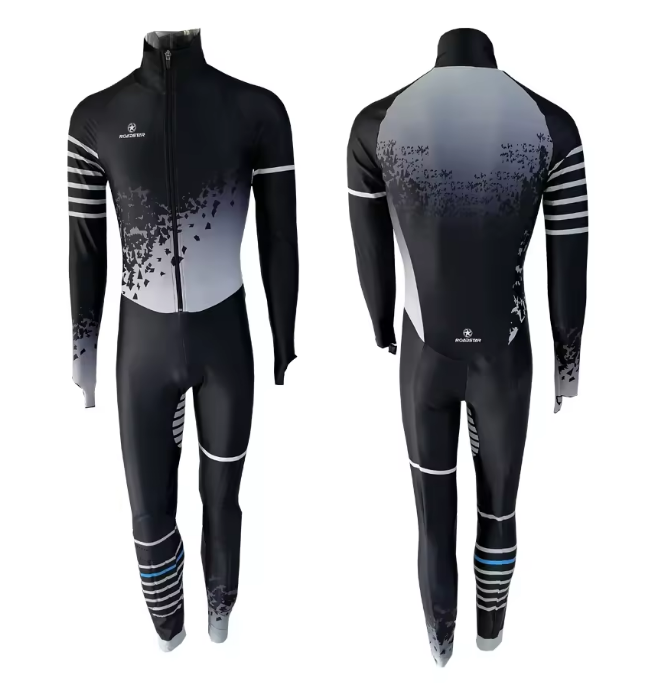
ISU-approved speed skating suits must meet strict cut-resistance requirements to protect athletes from blade injuries. Level 3 cut resistance is the common minimum standard for competitive short track suits, requiring certified protection against a defined cutting force. Manufacturers verify performance through standardized tests such as ISO 13997 (TDM-100), and skaters should always check certification labels rather than relying on fabric thickness alone.
Kevlar and Dyneema are the main fibers used for skating cut protection. Kevlar offers strong protection but is heavier, warmer, and more affected by UV and chemical exposure. Dyneema provides excellent cut resistance with lower weight, better flexibility, and improved comfort, but requires careful heat management. Full-body protection offers maximum coverage, while targeted panels reduce weight and improve mobility by protecting only high-risk areas.
Effective cut protection must cover critical areas such as the neck, underarms, groin, inner thighs, and ankles where major blood vessels are vulnerable. Short track suits may also include impact padding around knees and shins to reduce collision injuries. In addition to cut resistance, reinforced abrasion zones around the ankles and calves help prevent wear from carbon boots and blades, extending suit durability and maintaining performance.
A speed skating suit should be tested in the actual skating position rather than standing upright. The suit may feel extremely tight when standing, but it should become smooth and comfortable in a deep skating crouch. Excess fabric caused by choosing a larger size can create wrinkles and aerodynamic drag, while incorrect torso length can restrict movement, cause chafing, or create loose folds during skating.

Ready-made suits offer convenience and affordability but may create fit compromises for athletes with non-standard body proportions. Custom suits use detailed measurements or body mapping to create precise compression and eliminate excess fabric. Accurate fitting requires measuring key areas such as chest, waist, hips, inseam, and torso length to ensure optimal performance and comfort.
High-performance skating suits require durable hardware and secure boot integration. Quality locking zippers prevent accidental opening during races, while offset zipper designs reduce neck irritation. Foot stirrups and silicone ankle grips keep the suit properly positioned on the skater’s boots without limiting flexibility or comfort.
Skaters can choose between integrated and modular cut protection systems. Integrated designs combine protection directly into the racing suit for better stability but may increase weight and heat. Modular systems use separate protective layers, offering greater flexibility and easier maintenance, but require precise sizing to avoid restricting movement.
Suit performance declines over time due to stretching, sweat exposure, and material breakdown. Elastane gradually loses compression, reducing aerodynamic benefits, while protective fibers such as Kevlar can degrade from UV exposure and harsh cleaning methods. Proper washing, storage, and replacement schedules help maintain safety and racing performance.
Take exact body measurements using a flexible tape, focusing heavily on torso length and thigh circumference.
Consult your head coach regarding specific club safety mandates and discipline requirements before looking at brands.
Request fabric samples or sizing kits from reputable speed skating equipment retailers to test stretch recovery and material feel.
Perform the deep-squat test in front of a mirror with any new suit to verify there is zero fabric bunching across the hips and chest.
A: A speed skating suit should feel uncomfortably tight across the shoulders and chest when standing upright. It must fit like a second skin without any wrinkles or loose fabric. The true test of fit occurs in a deep skating crouch; in this position, the suit should feel supportive, smooth, and entirely comfortable without restricting your breathing or joint mobility.
A: Short track suits require comprehensive, ISU-certified cut-resistant materials in critical arterial zones due to the high risk of collisions in pack racing. They also often feature built-in knee and shin padding. Long track suits prioritize absolute aerodynamic efficiency and lightweight materials, as skaters race in isolated lanes with minimal collision risk.
A: High-quality suits utilize durable foot stirrups that loop under the foot to keep the leg panels pulled taut. Additionally, they feature silicone ankle grippers on the interior hem. These grippers stick to the smooth surface of the carbon boot, preventing the suit from riding up the calf and maintaining a seamless aerodynamic profile.
A: While not strictly mandated for casual recreational skating, cut resistance is highly recommended if you skate on crowded rinks or participate in amateur pack racing. A simple fall can expose you to the blades of passing skaters. A modular cut-resistant base layer offers excellent protection without committing to a professional racing suit.
A: ISU Level 3 is a safety standard set by the International Skating Union. It mandates that the fabric must withstand a minimum of 30 Newtons of cutting force, tested under the ISO 13997 standard. This ensures the material can stop a sharp skate blade from penetrating the fabric and causing severe lacerations during high-speed collisions.
A: Wash the suit inside out in cold water using a mild, bleach-free detergent. Never use fabric softeners, as they degrade the elastane and protective fibers. Do not use a machine dryer. Air dry the suit flat on a towel away from direct sunlight, as UV rays can rapidly destroy the structural integrity of Kevlar.


