
- CUSTOM PRODUCT
- PRODUCTS & DESIGN
- COMPANY & BRAND
- NEWS
- CONTACT US
Views: 0 Author: Site Editor Publish Time: 2026-08-10 Origin: Site


Apparel founders and team managers constantly face a frustrating friction point. You want to test a new activewear design, but factory minimums stand in the way. You have a concept ready for the market. However, manufacturing partners demand volume commitments that stretch your initial budget to the breaking point. Misunderstanding these production thresholds leads to two fatal errors. You either tie up critical cash flow in dead stock by over-ordering, or you destroy your profit margins with exorbitant per-unit costs by under-ordering. This guide serves as a technical framework for evaluating a custom sportswear MOQ. We break down the manufacturing variables that dictate these numbers, from fabric sourcing to printing techniques. You will learn how to determine the exact order volume required for your specific business stage, risk tolerance, and profit goals.
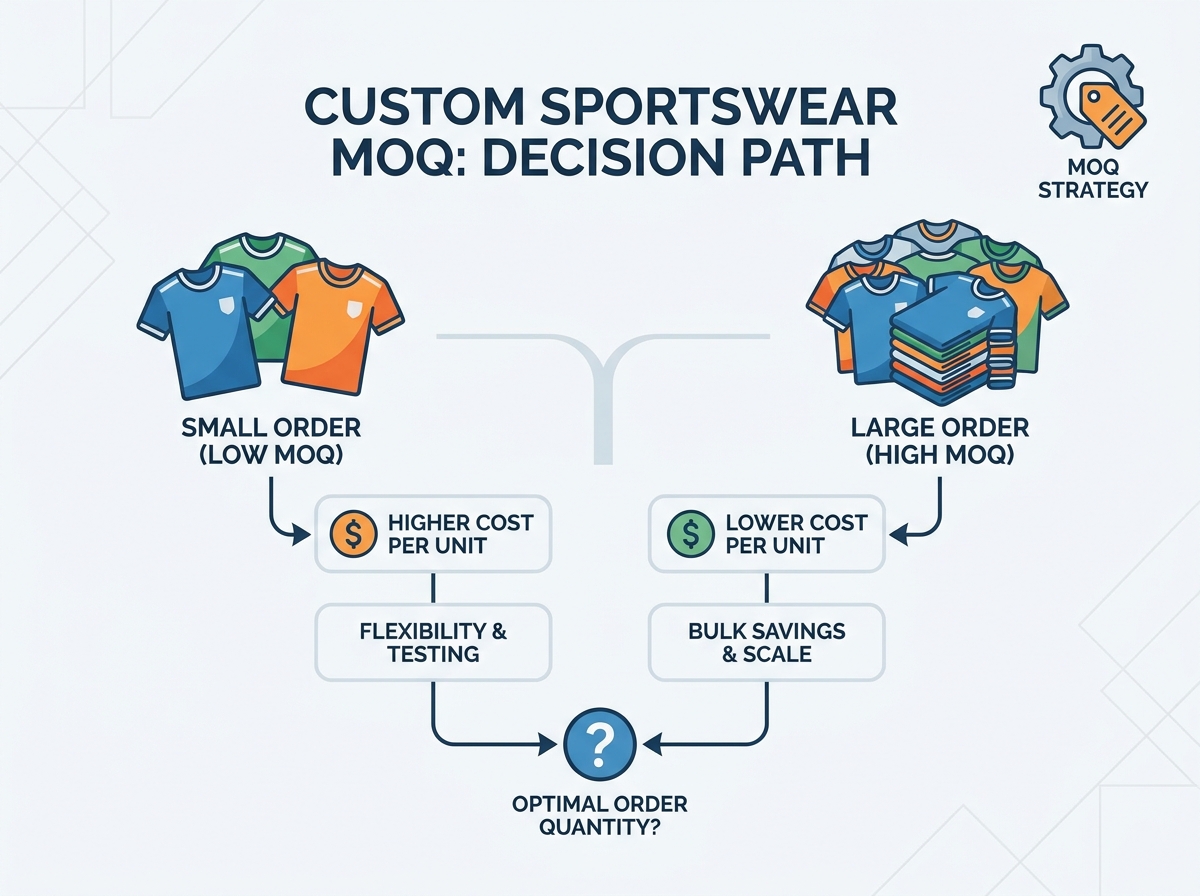
Baseline Ranges: Custom sportswear MOQs vary drastically by manufacturer type, ranging from 10–50 pieces for sports teams/testing, 50–150 pieces for emerging brands, to 300–500+ pieces for traditional bulk production.
The "Per Style" Rule: A factory's stated MOQ almost always applies per style and often per colorway, not as a cumulative total across your entire clothing collection.
Customization Dictates Volume: The level of customization—specifically custom-dyed fabrics versus stock fabrics, and screen printing versus sublimation—directly controls the factory's baseline MOQ.
The Margin Trade-Off: Lower MOQs reduce upfront inventory risk but carry significantly higher Cost Per Unit (CPU) due to fixed setup and tooling costs.
Strategic Negotiation: MOQs are often negotiable if brands standardize certain elements, such as consolidating fabric choices across multiple styles or utilizing standard colorways.
Table of Contents
Buyers often search for a single industry standard when planning their production runs. However, minimums are highly stratified. They depend entirely on the factory's operational model, target clientele, and product complexity. A facility built to outfit local soccer teams operates on completely different machinery and workflows than a facility engineering high-compression athletic leggings for a global retail brand. You cannot treat all production floors as equal entities.
The most common beginner misconception involves cumulative order totals. A 300-piece minimum usually means 300 pieces of a single design in a single color. It does not mean you can order 100 t-shirts, 100 shorts, and 100 hoodies mixed together to hit the target. Factories enforce these rules because every unique style requires a different pattern, a different marker layout on the cutting table, and a different sewing line configuration. Changing thread colors or fabric rolls halts production. When operators stop sewing to re-thread 15 different overlock machines, the factory loses money. Therefore, minimums apply to the specific garment and colorway to ensure the assembly line runs efficiently without constant interruptions.
Micro-batch production serves a very specific use case. This tier is ideal for local sports teams, gym merchandise, or initial market testing. Factories operating in this space optimize their equipment for rapid changeovers rather than long, continuous runs. They rely heavily on digital workflows.
The limitations here are structural. You are usually restricted to sublimation printing on pre-existing stock fabrics. You cannot request custom fabric blends or unique pantone dye lots. Because the setup time is amortized over very few garments, the cost per unit remains exceptionally high. You pay for agility and low inventory risk, not for margin optimization. The cutting room often uses automated laser cutters for single-ply fabrics rather than stacking 100 plies of fabric for a bulk cut.
This volume represents the sweet spot for emerging activewear brands. Launching a first collection requires market validation without extreme financial pressure. Factories handling 50 to 150 pieces bridge the gap between basic teamwear and full-scale retail production. They operate with a mix of manual and automated processes.
At this tier, capabilities expand significantly. You can submit custom tech packs, specify unique grading rules, and apply basic custom branding like woven labels or custom hangtags. However, you still rely heavily on available market fabrics. The factory will source rolls of fabric already produced by mills and sitting in wholesale markets. You cannot dictate the exact composition down to the percentage point. If you want a 75% nylon and 25% spandex blend, you might have to settle for a 73/27 blend that is currently available on the floor.
Established brands requiring high profit margins and complete control over garment engineering rely on traditional bulk manufacturers. This tier is where true custom apparel development happens. Factories demand these volumes because the setup process is intensive and highly specialized.
Committing to 300 or more pieces unlocks custom fabric milling. You can dictate proprietary dye lots for exact Pantone matching. You gain access to complex multi-material construction, such as laser-cut ventilation panels, bonded seams, and specialized waterproof coatings. The high volume absorbs the massive setup costs, driving your unit costs down and maximizing your gross profit. At this stage, the cutting room stacks fabric 150 plies high, and the sewing floor operates in a continuous, unbroken chain.
Factory minimums are direct mathematical reflections of the labor, material waste, and machine setup time required to produce a garment. Understanding these variables allows you to engineer your products to fit your desired order volume.
Standard teamwear, such as football kits or basketball jerseys, often enjoys lower minimums ranging from 10 to 20 pieces. Factories achieve this by using pre-graded pattern blocks. The design is already digitized, the sizing is standardized, and the cutting machines are pre-programmed. The factory only changes the surface artwork.
Contrast this with highly engineered garments like high-impact sports bras or waterproof outerwear. These items require rigorous tech pack interpretation, custom pattern drafting, and multiple rounds of prototyping. A high-impact sports bra might feature 15 different components, including underwires, specialized clasps, power mesh panels, and varying elastic tensions. Factories require higher minimums, often 150 to 300 pieces, to justify the complex research, development, and assembly line setup required for such intricate construction.
Fabric availability is the single largest bottleneck in apparel manufacturing. Using stock or deadstock fabric allows for low minimums. Stock fabric refers to rolls of material already manufactured and sitting in a warehouse. The garment factory simply buys what they need, cuts it, and sews it.
Custom milling presents a different reality based on raw material yields. If you want a specific 78% Nylon and 22% Spandex blend dyed to your exact brand color, the fabric mill must produce it from scratch. Fabric mills enforce their own minimums, often measured in hundreds of yards or kilograms. A single vat of custom dye requires a massive amount of raw material to process correctly. If a mill requires a 500-yard minimum, and your hoodie consumes 1.5 yards of fabric, the math dictates a 333-piece minimum. The garment manufacturer must enforce a 300+ piece minimum simply to consume the raw material they are forced to buy from the mill.
The method you choose to apply logos and graphics drastically alters production thresholds. Each technique carries distinct setup requirements on the factory floor.
Sublimation: This digital process allows for very low minimums, often 10 to 20 pieces. Sublimation uses heat to transfer dye directly into the fabric fibers. Because it is digitally driven, changing artwork between shirts requires zero physical machine retooling. It is ideal for all-over prints and complex team uniforms.
Screen Printing: Setup costs make low volumes economically unviable for screen printing. The factory must coat, expose, and wash out an individual mesh screen for every single color and every graphic size. If you have a three-color logo, that requires three separate screens. If you want the logo scaled down for a size small and scaled up for a size extra-large, that requires entirely new sets of screens. Factories usually require a strict 50 to 100 piece minimum to absorb this intense setup labor.
Embroidery & Heat Transfers: These methods carry moderate setup costs. Embroidery requires digitizing the logo file into a format the sewing machine can read, followed by hooping each individual garment. Heat transfers require cutting and weeding vinyl or ordering custom plastisol transfers. These techniques typically support moderate minimums around 50 pieces.
Every seam adds time to the production line. Complex paneling, articulated knees in joggers, or gussets in leggings increase the labor time per unit. Specialized stitching, like flatlock seams used in compression wear, requires dedicated machinery that must be perfectly calibrated for tension. Custom hardware, such as branded zippers, silicone-dipped drawstrings, or custom molded aglets, also require their own minimums from hardware suppliers. When your tech pack includes highly specific, non-standard elements, factories demand higher minimums to justify sourcing the components and training their sewing operators on the unique assembly steps.
Choosing your production volume requires balancing risk against profitability. You must evaluate how unit economics, cash flow, and production agility impact your overall business model.
Fixed setup costs remain static regardless of how many items you order. Pattern making, grading, machine calibration, and screen burning cost the same whether you produce 50 units or 500 units. When you order low volumes, those fixed costs are distributed across fewer items, driving up the cost per unit.
Consider a conceptual breakdown. A 50-piece order might yield a 40% gross margin when sold at retail, because the manufacturing cost consumes a massive portion of the revenue. A 300-piece order of the exact same garment distributes those fixed setup costs much wider. The unit cost drops significantly, potentially yielding a 70% gross margin. High volume production is the primary driver of retail profitability.
Margin optimization means nothing if your cash is trapped in a warehouse. You must analyze the risk of ordering 300 pieces of an untested design. If the market rejects the fit, the color, or the fabric, you hold dead stock. Liquidating dead stock destroys brand equity and drains capital.
Paying a premium for a 50-piece pilot run mitigates this risk. You accept a lower profit margin on the first run in exchange for market validation. The cost of capital tied up in unsold inventory is a silent killer for apparel brands. Low minimums protect your cash flow during the testing phases of a new product launch.
Production speed varies inversely with order size. Low volume orders often fit into factory downtime. Smaller runs utilize agile production lines, potentially offering faster turnaround times. You can restock popular items quickly or pivot to new trends without waiting months.
Massive bulk runs require extensive planning. Custom fabric milling alone can add four to six weeks to the timeline. Dyeing, cutting, and assembling hundreds of units takes significantly longer. High volume production requires disciplined forecasting to ensure you do not run out of stock during the extended lead times.
Comparison: Low Volume vs. High Volume Production | ||
Metric | Low Volume (50-150 pcs) | High Volume (300-500+ pcs) |
|---|---|---|
Unit Cost | High (Fixed costs spread over fewer units) | Low (Economies of scale achieved) |
Gross Margin | Lower (Typically 30-40%) | Higher (Typically 60-80%) |
Inventory Risk | Minimal (Easy to liquidate or test) | High (Requires proven market demand) |
Fabric Options | Limited to stock/market fabrics | Unlimited (Custom milling and dyeing) |
Lead Time | Faster (Agile production lines) | Slower (Requires extensive raw material prep) |
Your ideal order volume depends entirely on your customer base and your current stage of business growth. Use this framework to align your production strategy with your operational reality.
Local clubs, recreational leagues, and school teams operate with strict rosters. Over-ordering provides zero benefit.
Target 10 to 30 pieces to match your exact roster size.
Focus exclusively on sublimation manufacturers who specialize in standard athletic templates.
Avoid factories that charge high setup fees for adding individual player names and numbers.
New brands must protect their startup capital while proving their concept to the market.
Target 50 to 100 pieces per style to validate market demand.
Sacrifice the desire for custom-dyed fabrics and utilize high-quality stock fabrics instead.
Focus your budget on testing the fit, refining the branding, and building your customer acquisition channels.
Once you have historical sales data and predictable demand, your strategy must shift toward maximizing profitability and brand differentiation.
Target 300 to 500+ pieces to unlock economies of scale.
Leverage your historical sales data to confidently meet higher volume requirements without risking dead stock.
Develop proprietary fabric blends and precise Pantone matching to differentiate your brand from competitors.
Securing the right production volume requires navigating industry pitfalls and negotiating effectively with factory representatives. Protect your brand by understanding the hidden risks of extreme low-volume manufacturing.
Exercise extreme caution when encountering manufacturers claiming zero minimums. These are almost always print-on-demand or dropshipping operations. The trade-offs are severe. You suffer from a complete lack of quality control because you never inspect the garments before they ship to the customer. You are forced to use generic, off-the-shelf blank garments. You have absolutely no ability to customize the fit, alter the seam construction, or integrate performance features. Building a credible activewear brand is nearly impossible when you rely on generic blanks printed on demand.
Premium factories enforce minimums to maintain efficiency, but they are businesses looking for long-term partnerships. You can often negotiate lower minimums by standardizing your production requests.
Cross-Style Fabric Utilization: Instruct your design team to use the exact same fabric and color across multiple styles. If you use the same black nylon-spandex blend for leggings, sports bras, and bike shorts, the factory can pool the fabric consumption. This helps you meet the factory's raw material minimums while keeping the per-style garment minimums low.
Colorway Consolidation: Reducing the number of colors in a collection drastically lowers the production burden. Launching three styles in one core color is much easier for a factory to process than launching one style in three different custom colors.
Paying Surcharges: Offer to pay a Less Than Minimum (LTM) surcharge. If a factory demands 300 pieces, but you only want 150, offer to pay a premium on the unit cost to secure the smaller run. This compensates the factory for the inefficient setup time while allowing you to access premium manufacturing capabilities without over-ordering inventory.
Establish a safe adoption path with a new manufacturing partner. Never jump straight into a massive bulk order with an untested factory.
Order a paid sample to verify their construction quality, stitching accuracy, and communication skills.
Negotiate a small batch pilot run of 50 pieces to test the market and verify their consistency in production.
Commit to a bulk production order of 300 or more pieces only after the pilot run succeeds.
This phased approach builds trust and protects your capital.
Audit your tech packs to ensure you have clear, standardized specifications before contacting factories.
Calculate your absolute maximum upfront budget to establish a hard ceiling on your inventory investment.
Consolidate your fabric choices across multiple designs to increase your negotiating leverage with premium manufacturers.
Request comprehensive quotes from both low-volume and traditional bulk factories to compare landed costs and margin potential.
A: You can almost always mix sizes within a stated minimum, as grading is a standard part of the cutting process. However, mixing colors is rarely allowed. Factories usually apply minimums per colorway because changing fabric rolls and thread colors requires halting the production line and retooling the machinery.
A: Factories incur fixed setup costs for every production run, including pattern drafting, machine calibration, and screen burning. When you order a small quantity, these fixed costs are divided among fewer garments, resulting in a higher cost per unit.
A: Yes. Fabric mills require massive amounts of raw material to process a custom dye lot or unique material blend. Garment factories must enforce higher minimums on your clothing order to ensure they consume the massive rolls of fabric they are required to purchase from the mill.
A: A per style minimum requires you to order a specific quantity of one exact garment design. A per order minimum allows you to combine different styles, such as hoodies and shorts, to reach a cumulative total. Most reputable factories strictly enforce per style minimums.
A: Yes, negotiation is possible if you simplify the production process. You can negotiate by using the same fabric across multiple styles, reducing the number of colorways, or offering to pay a Less Than Minimum (LTM) surcharge to compensate the factory for setup time.
A: Sublimation is the ideal choice for small team orders. Because it is a digital printing process, it requires zero physical screen setups. This allows factories to produce highly customized, all-over prints with individual names and numbers at very low minimums.


